GITA-GEET (Introduction) गीता-गीत (भूमिका)

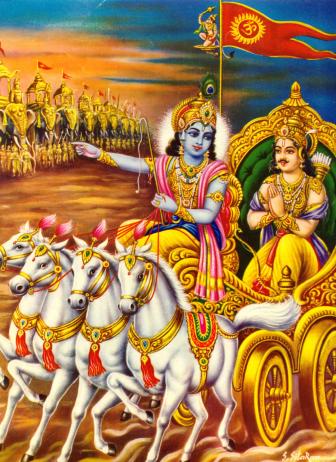
UNIVERSAL GURU LORD KRISHNA

कृष्णं वन्दे जगद्गुरुम्

Before the start of the Mahabharat battle, Arjuna wanted to be in the mid of battlefield to enable him to see the warriors of both the sides. As soon as he enters into the mid of battlefield,  he feels guilty about his decision to fight against his own kinsmen and becomes despondent.

All guilt is an emotional warning sign. Sometimes guilt-prone people carry a strong sense of responsibility to others, and that responsibility makes other people see them as leaders. If guilt is suppressed, it may result in laziness, suspicion and frustration. The worst thing one can do when feeling guilty is to do nothing or abandon one’s duty as Arjuna said “My limbs fail and my mouth is parched, my body quivers and my hairs stand on end; Gandiva slips from my hand”(As per Bhagwad Gita, chapter 1)

सीदन्ति मम गात्राणि मुखं च परिशुष्यति ।

वेपथुश्च शरीरे में रोमहर्षश्च जायते ॥

गाण्डीवं स्रंसते हस्तात्वक्चैव परिदह्यते ।

न च शक्नोम्यवस्थातुं भ्रमतीव च मे मनः ॥

Krishna convinces him that his guilt feeling is inappropriate. Gita is the teachings of Krishna imparted to Arjuna when he lost his nerve on the battlefield at Kurukshetra , when he became despondent on the battlefield at Kurukshetra, unable to withstand the challenge of having to fight his own relatives, teachers and friends.

The Gita is the world’s foremost school of self-management and enables us to be successful and happy. A few points of learning from Gita are as follows:

  • Be in present: Intelligent persons never worry about things happened in the past or likely to occur in future

अशोच्यानन्वशोचस्त्वं प्रज्ञावादांश्च भाषसे ।

गतासूनगतासूंश्च नानुशोचन्ति पण्डिताः ॥

  • Be fearless: We all are everlasting soul. Nobody can make any harm to it. So there is nothing to be scared of

वेदाविनाशिनं नित्यं य एनमजमव्ययम्‌ ।

कथं स पुरुषः पार्थ कं घातयति हन्ति कम्‌ ॥

  • Become Karmayogi (Be in action): A karma yogi takes pleasure in work itself, irrespective of its outcome. He enjoys living most of his time in the world of activity leading to his dream, rather than dwelling on the dream itself. He is focussed on `doing of work’ itself without the anxiety of a distant outcome at the end of the work. “You have right only to action, never to the fruits.” Don’t be attached to inaction nor be instrumental in making your action bear fruit as you have right only to act not in its results.

कर्मण्येवाधिकारस्ते मा फलेषु कदाचन ।

मा कर्मफलहेतुर्भूर्मा ते सङ्गोऽस्त्वकर्मणि ॥

  • Act to contribute for the universe (society as a whole): The human being is indebted to each and every member of the universe such as elements, trees, animals, sages, parents, teachers, ancestors and scientists for what he is today. One who enjoys favours from the universe but does not return those favours, is a thief. Any selfless action or action imbued with the spirit of reaching out is what is meant by the word yajna. Krishna says it is this spirit of offering or yajna which harmoniously moves the cosmic wheel.

कर्म ब्रह्मोद्भवं विद्धि ब्रह्माक्षरसमुद्भवम्‌ ।

तस्मात्सर्वगतं ब्रह्म नित्यं यज्ञे प्रतिष्ठितम्‌ ||

            Everybody is assigned a certain role in life. May that role be performed to the best            of one’s ability, not only for a personal gain but for the well-being of the            macrocosm. All duties and actions that one has to perform may be looked upon as an opportunity to     serve the universe.

  • Adopt appropriate life style to get rid of problems:

युक्ताहारविहारस्य युक्तचेष्टस्य कर्मसु ।

युक्तस्वप्नावबोधस्य योगो भवति दुःखहा

  • Develop yourself for growth: Always be busy in improving tour actions in order to grow. You yourself are your friend if you raise yourself to develop for the further growth, else you are your own enemy if you remain depressed.

उद्धरेदात्मनाऽत्मानं नात्मानमवसादयेत्‌ ।

    आत्मैव ह्यात्मनो बन्धुरात्मैव रिपुरात्मनः ॥

Thus the Gita offers many more valuable principles of life that you can use to achieve success and happiness in the world.

The Gita speaks of excellence ­ in the world and beyond. It inspires you with a higher ideal. Move from mere physical delights to emotional motivation, intellectual stimulation and the highest ­ the lure of the Infinite. The world does not need more brilliant or talented people. It needs ordinary people with extraordinary motivation. With a higher ideal you tap into your potential, become creative and energetic, and transform from an ordinary mortal to an extraordinary immortal.

GITA IN CONTEXT OF THE MAHABHARAT

In ancient times there was a king Shantanu who had very capable and brave son Devavrata Bheeshma who was the greatest warrior and nobody ever dare to challenge him. Bheesma’s mother left in his early childhood. He took oath not to become king and also not to marry to facilitate his father to marry again with Satyvati who put the condition that only her son should become king of Hastinapur. He assured to his step mother to facilitate by remaining loyal to Hastinapur and help her sons and grand-sons to rule. Before marriage, Satyavati was having a son Krishna Dvaipayan, popularly known as Rishi Veda Vyasa. Shantanu and Satyavati had two sons – Chitrangada and Vichitraviryan. Bhishma loved and adored his two brothers and in turn the two of them worshiped the ground on which Bhishma walked. But both of them died early. She had two grand-sons, Dhritaraashtra and Paandu. The former was born blind, therefore, Paandu inherited the kingdom. Paandu had five sons. They were called the Paandavs. Dhritaraashtra had one hundred sons. They were called the Kauravs. Duryodhana was the eldest of the Kauravs.

After the death of king Paandu the Paandavs became the lawful king. Since they were still in their childhood. Dhritaraashtra was made king and Bheesma was taking care five sons of Pandu and 100 sons Dhritarashtra. Also he took responsibility of protecting the kingdom as a supreme commander of the army.. Duryodhana was a very jealous person. He also wanted the kingdom. The kingdom was divided into two halves between the Paandavs and the Kauravs . Duryodhana was not satisfied with his share of the kingdom. He wanted the entire kingdom for himself. He unsuccessfully planned several foul plays to kill the Paandavs and take away their kingdom. He even ordered to disrobe Pandavas wife Queen Draupadi in front of King’s court. He unlawfully took possession of the entire kingdom of the Paandavs.

He refused to give back even five villages without a war. All mediation by Lord Krishna and others failed. The big war of Mahaabhaarata was thus inevitable. The Paandavs had only two choices: Fight for their right as a matter of duty or run away from war and accept defeat in the name of peace and nonviolence. Arjuna, one of the five Paandava brothers, faced the dilemma in the battlefield whether to fight or run away from war for the sake of peace. Arjuna’s dilemma was the biggest of all. He had to make a choice between fighting the war and killing his most revered guru, very dear friends, close relatives, and many innocent warriors or running away from the battlefield for the sake of preserving the peace and nonviolence.

krishna-arjuna

Arjuna’s dilemma is, in reality, the universal dilemma. Every human being faces dilemmas, big and small, in their everyday life when performing their duties.
Lord Krishna spoke the Bhagvad geeta to Arjuna at the battle of Kuruksetra near New Delhi, India in 3137 B.C. near New Delhi, India in 3137 B.C.
The entire seven hundred verses of the Gita is a discourse between Lord Krishna and the confused Arjuna on the battlefield of Kurukshetra. This discourse was narrated to the blind king, Dhritaraashtra, by his charioteer, Sanjaya, as an eyewitness war report.
Bhagvad gita is the part of the great epic MAHABHARATA written by VedaVyasa.

In order to achieve success in life, one must be aware of the purpose of his own life, supreme reality, and its relation with the life. Lord Krishna explained the same in Gita.  The Gita can, therefore, be divided into three parts of six chapters each on the basis of the topics covered;

  1. Purpose of life
  2. Supreme Reality
  3. Relation between Individual and Supreme Reality

1. PURPOSE OF LIFE

First part talks about the human being as an individual. All the human being meet challenges and are overwhelmed by them. Everybody needs to understand the purpose of life and conduct accordingly . It is karma yoga, path of action. Karma yoga is working for a higher cause in the spirit of cooperative endeavour.To involve in social service and carry out the good work without expecting any reward for it. When a person functions thus his worldly desires wane away and he is prepared for meditation. Through meditation he realises his Self, the purpose of existence. This is the surest way for salvation.

2. SUPREME REALITY

Krishna shows how Reality or God is in everything and everything is in God. He demonstrates this both by analyses and syntheses. He names individual things and says they are God and then puts it all together, synthesises them in the form of Vishwarupa, His cosmic form. In it, Arjuna sees how everything is part of Krishna or Reality , the good, the bad and the ugly . Whatever one sees is a manifestation of the Lord. With this vision one’s mind expands in love.

3. RELATION BETWEEN INDIVIDUAL AND SUPREME REALITY

Supreme Reality is the root and the world is the tree, the inverted ashvatha tree. Like any family tree, the parent is shown on top and the descendants below. The world is made up of the three gunas ­tamas, ignorance; rajas, activity; and sattva, poise. They bind us in different ways and keep us from recognition of Reality .Beings in the world are all different ­ but different combinations of the three gunas. When one goes beyond the gunas one finds one’s true Self.

Thus, Lord Krishna explained in The Gita that everybody is assigned a certain role in life. May that role be performed to the best of one’s ability, not only for a personal gain but for the well-being of the macrocosm. All duties and actions that one has to perform may be looked upon as an opportunity to serve the universe. By the spirit of offering, of contributing, the individual has struck chord of harmony playing in the fine chord of harmony playing in the universe. The spirit of offering, the attitude of serving or reaching out is such a catalyst that it purifies his heart of selfishness, greed, aggression, violence, usurpation and other such self-centred tendencies and makes it pure and divine. Purged of these discordant tendencies, he is free from anxieties and conflicts. In a nutshell, selfishness is equal to unhappiness and selflessness and reaching out is equal to happiness and peace.

CONCEPT OF GEETA

(Introduction series)

There is a certain order and harmony in the universe, as everything in this universe is balanced by different types of positive and negative forces. So, there is the need to instruct or guide the individual to remain in concord with the prevailing harmony in order to enjoy in this universe. The concept of the human life is based on the principles of eternal enjoyment The Bhagwad Gita explains:

  • the nature of the world around an individual in the universe
  • different types of personality to deal with
  • the technique of right contact with the world.

Nature of the world

  1. The world is a mix of pairs of opposites; i.e. (dualities of life) such as kindness and cruelty , happiness and misery , intelligence and foolishness, knowledge and ignorance, truthfulness and falsehood, fear and fearlessness, birth and death, violence and equanimity , fame and infamy.
  2. all of these are created by the Supreme to maintain balance.
  • It is constantly changing and is unpredictable.

Individual’s Personality: Everyone is bound by their inherent nature and cannot act apart from inborn traits. Once you come to terms with this, you will not expect an angry person to be gentle or a hysterical person to be sane. You will know exactly how to deal with them without getting upset.

Your personality: Look within and find out:

  • What motivates you and drives you to action?
  • How is it that at times you are serene and tranquil, at most times agitated and disturbed, and at still other times lazy and indolent?
  • What are your strengths and weaknesses?
  • Are you happy being the way you are or do you want to become a better person.

The Bhagwad Gita is a scientific manual for the art of  living and enjoying  life. One can say that  Gita is the world’s foremost school of self-management that enables us to be successful and happy. It explains how to assess

  • the world,
  • your surroundings and
  • the people you interact with regularly .

It also explains how to insulate from shocks of life and enjoy the thrills without pain and suffering.

YUGADI NAVDURGA युगादि नव दुर्गा


Ugadi Navdurga युगादि नवदुर्गा

The word Ugadi is derived from the word Yuga adi (Yuga युग + Aadi आदि ). Yuga means the period or era and Aadi means the beginning. Uga उग  also means commencement of germination. So this is the  day when creation had started in the universe.

The universe is created from the Energy which pervades everywhere and had existed on its own all along throughout a timeless eternity in one or other form of the energy. Universe is nothing but energy. Since energy can neither be created nor be destroyed, it can safely be considered that Universe was never created, Universe will never die. Supreme Energy that is being recognized as the Super power or Supreme God/ Goddess. Adishakti आदि शक्ति  is the name given as per Indian mythology. Adishakti created three types of forces in the form of Trinity of Gods. Trinity of Gods Shiva, Brahma and Vishnu are the forms of universal forces: Nuclear forces, Gravitational forces, and Electro-magnetic forces respectively.

Scientific theories proved that matter is no more than insubstantial fields of energy moving in a great emptiness (space) or ‘shunya’(शून्य)  that pervades and surrounds everything. Thus all objects and living things have no substance except as bundle of energy. Thus different stars and planets like sun, moon, earth, etc. have been formed from the energy and sustained in the universe with the help of the forces like gravitational, nuclear, and electromagnetic forces. Gross elements (earth, water, air, fire and space) were created .

In Bhagawad Geeta it is given how everything in the universe goes back to its original nature after a predetermined period (kalpa कल्प ) and in the beginning of the next kalpa, the same comes out from that original nature again.

सर्वभूतानि कौन्तेय प्रकृतिं यान्ति मामिकाम्

कल्पक्षये पुनस्तानि कल्पादौ विसृजाम्यहम् ||

The day Kalpa had commenced known as Kalpaadi कल्पादि. With the interaction of different forces and planets, movements in gross elements started taking place. Sun and earth started giving movement to air and fire in the space; moon affected water on the earth, Thus all the five gross elements started playing their role for the creation.

Ugadi is assumed as the day the Creator (Lord Brahma ब्रम्ह) had commenced the creation. It is the beginning of an Era/Yuga in which currently we are living. To commemorate the commencement of Creation, this day is celebrated as Ugadi.

ASTRONOMICAL CYCLE AND YUGADI: The creator of the universe, began a series of wonderful creations, including that of and all the life forms that live in the earth. Yugadi is not only a beginning of Year according to the Hindu calendar, but also sets the new astronomical cycles into motion.

Sun and Earth’s Orbit: The sun, the source of light and life to every living being is a unifying force. Because the plane of the ecliptic (the plane of the Sun’s apparent path on the sky) is titled with respect to the celestial equator (the plane perpendicular to the earth’s spin axis), the respective hemispheres receive more direct or less direct sunlight at different times in the earth’s orbit around the Sun.        Equinox
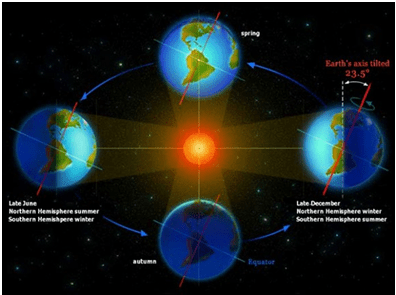
There is the role Earth’s orbit plays in the seasons, which we referred to above. The four seasons are determined by the fact that the Earth is tilted 23.5° on its vertical axis, which is referred to as “axial tilt.” This quirk in our orbit determines the solstices – the point in the orbit of maximum axial tilt toward or away from the Sun and the equinoxes, when the direction of the tilt and the direction to the Sun are perpendicular.

Solar Declination Angles for the Northern Hemisphere

Spring Equinox Mar. 21/22 = 0o
Summer Solstice Jun. 21/22 = +23.5o
Autumnal Equinox Sept. 21/22 = 0o
Winter Solstice Dec. 21/22 = -23.5o

When the Sun’s path crosses the equator, the length of the nights at latitudes +L° and -L° are of equal length. This is known as an equinox. There are two solstices and two equinoxes in a tropical year. An equinox is an astronomical event in which the plane of Earth’s equator passes through the centre of the Sun, which occurs twice each year, around 20 March and 23 September. After the summer solstice the Sun follows a lower and lower path through the sky each day until it reaches the point where it is in the sky for exactly 12 hours again. This is the Fall Equinox. After the Fall Equinox the Sun will continue to follow a lower and lower path through the sky and the days will grow shorter and shorter until it reaches its lowest path and then we are back at the Winter Solstice where we started.

Just like the Spring Equinox, the Sun will rise exactly east and set exactly west on this day and everyone  will experience a 12 hour day. Spring equinox signifies that days are getting longer (after the darkness of winter), while autumn equinox represents the days becomingsun-position shorter as we prepare for winter ahead).
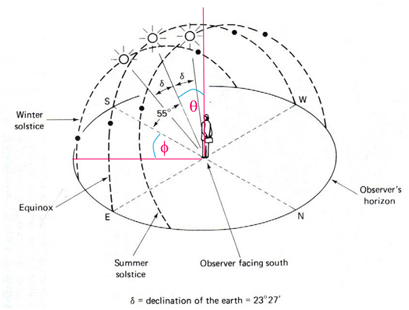
The days are longer around the summer solstice and shorter around the winter solstice.

The significance for Spring, is that daylight starts to increase, so the earth is about to tip over to more LIGHT, like an illuminating, sublime reminder that light is returning and always does, to earth. Therefore, the Spring equinox represents new light and life, new beginnings, seeds and paths.

This cycle of the earth  around the sun spiritually symbolises light and darkness, life and death. So with summer (the summer solstice) we have the beginnings of new creation, and with the winter solstice the endings and death (metaphorical), of course, but also related to nature’s cycle.

TIME ELEMENTS: As the Earth orbits the Sun in 365 days (called a year), the Moon orbits the Earth.

Moon’s orbit and lunar months: The Moon’s orbit lasts 27.5 days, but because the Earth keeps moving, it takes the Moon two extra days, 29.5, to come back to the same place in our sky. This is called lunar month or Chandramas चन्द्र-मास.  As per Chandramas the lunar month is denoted by the star on the full moon day. For example when the full moon day is in the star constellation of Chitraचित्रा that month is referred to as Chaitra Masa चैत्र-मास  whose beginning day is celebrated as Ugadi.

Zodiac and constellation: After generations of observation or investigation, our great saintss (Sages) concluded that the “key lies in the heavens”. They divided the apparent sky into stellar zones for reference, like we divide land by fixing fences!

Zodiac or Rasi Chakraराशि-चक्र is a circular path with constellations as mile stones. These stellar zones are termed as constellations, stars, asterisms etc. Therefore at any point of time a constellation will rise in the east and another constellation which is 180 degrees away from it sets in the west. After keen observation and research our saints recorded the properties of these constellations and designed rituals in symmetry with them. Among the constellations, those rise and set in a particular period have strongest influence on our nature.zodiac
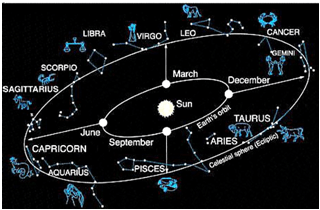
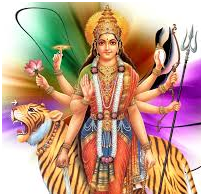
Astronomical status on Yugadi/ Nav Durga: On “Yugadi” day Sun sets his journey towards East and when he enters Mesha Rasiमेष-राशि  (Aries) becomes very powerful. Astrologically Mesha Raasi (Aries) is the sign of exaltation for Sun. Aswin Maasआश्विन मास  is when Full Moon day forms in Aswini star. During this month before sun rise on the horizon, we can visualise the constellation “Simha” सिंह-राशि (Leo) and later Kanya कन्या-राशि (Virgo) hence we have the image of “Durga Maa दुर्गा माँ as a “Woman sitting on Lion”. The same scene will repeat 6 months later but after sunset on the horizon in the month of Chaithra. So, there is a festival called “Vasanth Nava Durga” celebrated during the first 9 days of chaithra maas shukla pax. Durga
Ugadi is basically a Hindu festival signifying the time element of the Universe which is celebrated as a new year day coinciding with the first day of Chaitra Masa शुक्लपक्ष Sukla Paksha, Prathama Thithi as per the Hindu Lunar Calendar

  • वसंत (Spring season) is first among the six seasons, in a year spring वसंत, summer ग्रीष्म, rainy-season वर्षा, autumnशरद, winterहेमंत, extreme-winterशिशिर.
  • मेष-राशि Mesha Raasi (Aries) is first among the zodiac signs,
  • चैत्र-मास Chaitra Masam is first among the Lunar months,
  • शुक्लपक्ष Sukla Paksha is first among the fortnights,
  • प्रथमा Prathama is first day among the lunar days.

The day that coincides with the confluence of all the above mentioned is celebrated as Ugadi. It is an occasion that also signifies the end of an era and beginning of a new era. The spring (वसंत Vasantaa Ritu) has come in all its beauty and freshness. It is the season when nature presents her most glorious appearance. The advent of Spring means every tree is in bloom. with plants, shoots, and leaves coming to life and therefore, the day is believed to set things rolling for a fresh and successful new beginning.

It also marks the beginning of as the Hindu New Year (नूतन संवत्सर Nootana Samvatsara) Ugadi. Chandragupt Vikramaditya became king on this day 2074 years before. That is the current year is known as Vikrami samvat विक्रमी-संवत 2074. Also it is known as 5119 Yugabda युगाब्द. It means counting the number of years from the beginning of the कलियुग kaliyug 5119 years have passed.

Celebration of ‘Yugadi’ and ‘Nav Durga’: In ancient times rituals were performed at the moment of alignment and people would cleanse old energy out as well as in their homes, temples etc. So you see how reclaiming the sacred ways and mindset past brings us closer to both the Great Spirit as well as a closer truth. Balanced equilibrium as the ideal state for our lives. The celebrations and prayers (for Maa Durga) and worshiping girl children (Kanya कन्या)  that follow fill people’s hearts with joy and contentment. Starting afresh with positive expectation is one of the key aspects of Ugadi. It is a time of renewal, new beginnings of life and  growth blooming gloriously and ushering in a renewed sense of  energy  brought in to help you focus and move forward in new, fresh, positive ways.    

There is also a health message involved in keeping fast and eating specific items these days. For example, Neem नीम is good for diabetes, skin diseases and acts as a blood purifier. It is called as Sarva roga nivarini सर्व-रोग निवारनी. Even today usage of neem leaves is prevalent in rural areas whenever anyone is infected with small pox/chicken pox. Jaggery helps in increasing the haemoglobin content of blood that helps in iron deficiency, Tamarind helps in removing excess of kaphaकफ, vataवात , and pittaपित्त , raw Mango works in throat related problems and enhances the appetite, Chillies removes kapha and vata, pepper helps in cold and works in throat related problems.

Thus Yugadi and Nav Durga reminds that season is going to change. The rituals are performed to give indication for change of life-style according to the change of season in order to ensure disease free healthy life.

YUGADI AND NAV-DURGA

Ugadi NavdurgaUgadi Navdurga

https://mail.google.com/mail/u/0/?ui=2&ik=cd4c8e1f60&view=att&th=15b258d9dbe18187&attid=0.1&disp=inline&realattid=f_j0y565zl0&safe=1&zw

पुनर्मनमिलन गीत

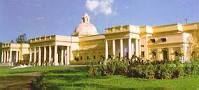
roorkee-university

# पुनर्मनमिलन गीत #

(अर्धसदी पर रुड़की-विश्वविद्यालय की स्मृतियाँ)

भागीरथ ले कर आये पावन  गंगाजल  धारा |

   थॉम्प्सन-कॉलेज सिविलज्ञानगंगा हित बना सहारा||

                     जीवन सरिता कर्मों की धारा बन हुई प्रवाहित|

                     यांत्रिक आभियांत्रिकी ज्ञानगंगा में हुई समाहित||

विश्वविद्यालय से आइआइटी अब संस्थान हमारा|

थॉम्प्सन-कॉलेज सिविलज्ञान गंगा हित बना सहारा||

                     हैंगर में साप्ताहिक फिल्मों की थी सदा प्रतीक्षा|

                     दीक्षान्त-समारोह में यहाँही, ली थी अन्तिम-दीक्षा|| 

याद रहेगा सदा शताब्दी द्वार का यही किनारा|

थॉम्प्सन-कॉलेज सिविलज्ञानगंगा हित बना सहारा||

                     गोविन्द-भवन आजाद-भवन रवीन्द्र-भवन के प्रांगन|

                     देख अभी भी रोमांचित हो जाता अपना तन मन||

कर्म-पथ विज्ञान-पथ चल व्यवसायिक लक्ष्य संवारा|

थॉम्प्सन-कॉलेज सिविलज्ञान गंगा हित बना सहारा||

                     कमलानी मनकानी शंकर लाल गुरु थे अपने |

                     गेंधर जी की वर्कशाप आरपी के थर्मल सपने||

अनुशासन में  रहें डीन एस आर सिंह ने हुंकारा |

थॉम्प्सन-कॉलेज सिविलज्ञान गंगा हित बना सहारा||

                     क्लास सीनियर पीके अग्रवाल की बात अजब थी|

                     एनसीसी में एसजी अवस्थी की भी पकड़ गजब थी||

यूनिवर्सटी-सीनियर पंत मधुर-व्यवहार से लगता प्यारा |

थॉम्प्सन-कॉलेज सिविलज्ञान गंगा हित बना सहारा ||

                     नहीं भूलपाते  नवयौवन पर संग  देखे सपने|

                     साथमें खाते पढ़ते खेलते सब लगते थे अपने||

  अर्धसदी पर पुनर्मनमिलन से भर दें रंग  न्यारा |

    थॉम्प्सन-कॉलेज सिविलज्ञान गंगा हित बना सहारा ||

                                                -भगवती प्रसाद गुप्त

KARMAYOGA

गीतोपदेश

MENTAL STATUS OF A KARMAYOGI

कर्मयोगी के चित्त की स्थिति

प्रशान्तमनसं ह्येनं योगिनं सुखमुत्तमम्‌ ।

   उपैति शांतरजसं ब्रह्मभूतमकल्मषम्‌ ॥6-27॥

   यथा दीपो निवातस्थो नेंगते सोपमा स्मृता ।

       योगिनो यतचित्तस्य युञ्जतो योगमात्मनः ॥6-19॥

प्रथम नव-अम्बर तनमन ले आनंद धाम में आयें |

हो प्रशांत दीपक जीवन के परम लक्ष्य को पायें ||

      है प्रशांत मन ही तो केवल उत्तम सुख का साधन |

      शांत रजोगुण क्रोध कामना रहित रहे मन पावन ||

स्वयं सदृश अनुभव कर सबमें ब्रम्ह्भूत होजायें|

हो प्रशांत दीपक जीवन के परम लक्ष्य को पायें||

      दीपक की लौ दे प्रकाश यदि बाह्य हवा न हिलाए|

       अपने अपनों हित चित्त को बाह्य तत्व न भरमापाए||

मिट्टी के तन दीपक में स्नेह सुधा भर लायें|

हो प्रशांत दीपक जीवन के परम लक्ष्य को पायें||

      आत्म विकास करें लेखनी संग सृजन तन्मय हो|

      शौर्य सदा दे साथ कभी न कहीं किसी से भय हो||

कर्मयोग की करें साधना जीवन सफल बनाएं |

 हो प्रशांत दीपक जीवन के परम लक्ष्य को पायें||


Eternal Happiness is the mental status of a KARMAYOGI. Our ultimate goal is to be constantly in the status of eternal bliss. In order to achieve the status, one has to understand the basic constitution of  human being. A human being is born with two bodies mental-body and the physical-body. Mental body is just like your undergarments that cannot be seen by others unless you expose. All others can see your physical body only.

One can attain the status of eternal happiness only if he has eternal peace in mind and inactive ‘RAJOGUNA’, i.e. there is no sign of anger and expectation with anybody. Anger and expectations are the products when ‘RAJOGUNA’ is active. In this status, one starts feeling everything including himself as a part of the Supreme Being i.e .BRAMHABHOOTA. So his action will always be sinless.

Our body is made up of earthly elements and lamps are also made of earthly soil. Light of the lamp gives light only if it is not disturbed by the wind of air from outside and it is full of oil. Similarly one can give light of happiness to others around him only if his mental status is not disturbed by the external happenings and is full of affection.

For self development, one should always be busy creating something new with the suitable instruments like pen, brush, computer, etc. One should always be full of inner strength so that he is always fearless and not scared from anything/ anybody. In this way one is able to apply KARMAYOGA and get success in life.

NAV DURGA

NAV DURGA AND NAVARATRI

Axis of the Earth is inclined at 23.5 degree from the axis of its orbit in which it revolves around the Sun. Thus astronomically, earth undergoes two major sun operations in a year. Seasons are dependent on the direction of the relative movement of the sun. Once when the sun appears to move southward of the equator (Dahshinayana). During this period, intensity of the sun is not harsh and the environment is full of moisture. The second is when the sun appears to move northward. In this period the sun rays are more intense and the environment is more of a dry kind. The first signifies the onset of winters and the second signifies the coming of summers

Thus two times, the two seasons combine. During these periods human body becomes more prone to diseases as it is less resistant, both physically and mentally to the attack of outside environment, micro organism, bacteria and viruses.

The first union of two seasons comes in March end to mid April (CHITRA SHUKLA PRATIPADA TO NAVAMI as per Hindu calendar) and second one comes in September  end/anywhere in October month (ASHWIN SHUKLA PRATIPADA TO NAVAMI as per Hindu calendar). These nine days/nights are called NAVRATRI.

Remedial measures to combat the possible disease is the deep significance in celebrating the NAVRATRI. Our body acts as a fortress; and body’s immune system is the army that  defends our body-systems from the outside environment and foreign bodies such as micro organism, bacteria and viruses. In Sanskrit fortress is called DURG, That is why these two periods have been termed as NAV DURGA also. It signifies that we should renew our body system (DURGA) by detoxifying by keeping ast, purifying the environment by HAVAN or YAGYA. Also we need to get rid of all the negative feelings and emotions. Our nervous system needs to be strengthened by performing a specific meditation (SADHANA) each night of NAVRATRI in the manner specified for that (NAV DURGA) day in order to rejuvenate our mind and nerves in order to make our body capable to fight disease and get success in life.

There are seven centres of energy or Shakti in the body called energy centres (chakras in Sanskrit). In modern medical science, we are studying about the sensing nerves and motor nerves passing through the spinal cord and connecting different parts of the body to the brain. The Chakras are thought to represent the whole body with the Devi in different forms, residing in different chakras. Different emotions are linked with each of these energy centres.

These chakras manage our body’s energy. They receive, assimilate and distribute energy to our energy centres. Malfunctioning of chakras triggered by negative thoughts and actions may restrict the movements of the life force from one to other and cause the energy system to haywire. You could fall ill. So tuning of the chakras continually is vital for regular upkeep of physical, mental and emotional health. Balancing chakras is central to our wellbeing.

1st DAY Goddess Durga Shailputri:  Goddess Shailputri is that divine root chakra (MOOLADHAR CHAKRA) that helps devottes begin their path of self realization. The first chakra, muladhara, is located in the base of the spine. Here, the energy manifests as inertia or enthusiasm. The root chakra rules the base of the spine, the rectum, lower limbs and supports the physical body, bones, and immune system. It also controls your mental and emotional thought patterns that can cause an imbalance.

Belief patterns stored in the root chakra include beliefs about family, community, law and justice, society, sexuality, survival issues, including thoughts of retaliation and revenge, and an inability to grow and express one’s self within the family.
Physical dysfunction related to imbalances leads to chronic lower back pain, varicose veins, rectal tumour or cancer, depression, and immune-related disorders.

During the Navratri puja, the devotee focus their minds towards the root chakra at the bottom of the spinal cord, which is the beginning of their spiritual discipline. When we begin to evaluate our beliefs honestly, we find that certain beliefs once valid are no longer so, and that we can get rid of them. So, we can get rid of beliefs that work against our well-being and happiness, substituting them with valid beliefs and higher values. One way is to make positive statements and be peaceful.

When awakened, begins the journey upwards. Since she begins her journey upwards, her puja is said to ring in success in all forms.

2nd Day Goddess Durga Bramhacharini: By worshiping this form of Goddess Durga, one develops the intent of sacrifice for creativity. For this concentration is required to wards the second energy centre,  swadhistana chakra. It  is the sex centre just four inches above the base of the spine vibrating from the pubic bone. This chakra controls the sexual instincts. Here energy manifests as pro-creativity or creativity. This creation is a mental product rather than a physical one. Creativity gives one a pleasure and wonder that child feels on seeing a new object. Hence by balancing this chakra, one becomes creative. This chakra is linked with the Adrenal gland which secretes a hormone named Adrenaline. When this gland functions well and there is no blockage of energy, one is vey self confident. Adrenaline induces enthusiasm, courage, faith and strength etc. and prepares the body and mind to endure or react in cold, heat, defence, struggle, self defence etc. Under the influence of this hormone one tries to create his own identity and existence. He also make an effort to know his own self.

3rd Day Goddess Durga Chandraghanta: By worshipping this form of Goddess Durga, the Manipur Chakra is awakened in the worshipper. The third chakra, manipura, is in the navel region located on the solar plexus in the lower thoracic area, at the controlling point of the pancreas. Here energy manifests as four emotions: Generosity , joy, greed and jealousy (two positive and two negative emotions). Pancreas is the corresponding gland of this chakra. This chakra helps in producing digestive juices and a hormone named insuline which oxidises glucose and provides strength to the body. When this chakra is completely balanced one sees himself in the family, society country and everywhere. His relation with others will always be cordial. Everyone likes meeting him. In case of imbalance one feels lonely and neglected. Activation of this chakra grants one the gift of speech and he becomes a gifted speaker and orator.

4th  Day Goddess Durga Kushmanda: By worshipping this form of Goddess Durga, theAnahat Chakra or cardiac chakra is awakened in the worshipper. or cardiac chakra. The fourth Chakra, anahata, is located in the chest region where energy manifests as three emotions ­ love, fear and hatred. The Thymus gland which motivates the body to fight bacteria and viruses is also located here. Anahat chakra is the centre of love and compassion — not possession or selfish emotions — located in the thoracic region, lies in the heart, (the solar plexus) and is associated with air (atmosphere) i.e. related with Vata.  It emits a mysterious cosmic vibration as of un-struck sound. That is sound beyond the realm of senses. This gland is active in childhood and lies inert on his growing into an adult. Inactivity of this chakra may result in problems related to the lungs, liver and blood circulating system. An active and balanced chakra ensures emotional satisfaction and his heart is always full of love for everyone without any ill will for anyone.  Activation of this chakra Opens the way to self realisation. Inactivity and imbalance of this chakra may present problem to heart and chest and emotional problem.  So the worshipper is bestowed with the boon of long and trouble free life as the anahat chakra in him awakes.

5th  Day Goddess Durga Skand Mata: By meditating on this form of Goddess paying attention on the vishuddhi Chakra, which is located in the throat region where energy manifests as two emotions ­ gratitude and grief. Thyroid and Para-thyroid glands are also positioned here which help in the physical and mental development. These glands keep on check on the level of iodine and calcium in the body and maintain the strength of the bones. If this chakra is inactive and unbalanced there may be diseases related to thyroid gland and throat and find himself in pain and sadness without any obvious reason. Everything in the world appears to him wrong. Vishuddhi chakra is the seat of art and higher forms of creativity governing the highest physical aspect of creation, art, definitely over and above other physical aspects of creation.. All artists have a pronounced vishuddhi chakra, but this centre is also directly connected with the swadhishthan. When this chakra is awakened, one starts feeling that I am one with Supreme Power i.e. oneness. It penetrates thyroid glands also and digestion increases.

6th  Day Goddess Durga Katyayani: By worshipping Goddess Katyayani, the worshipper is bestowed with awakening of AGYA CHAKRA. The Agya chakra is located between the eyebrows where energy manifests as anger and alertness. Pituitary gland (referred to as master gland) is also located here. This chakra provides soundness to the mental state of a person. One is able to accomplish his tasks with determination and zeal. He is also able to exercise a strict control over his sensory organs. Here, Devi is six-faced, representing the five senses (sight, hearing, smell, touch, taste) and the mind.

7th  Day Goddess Durga Kaalratri: While worshipping this Goddess, one should start experiencing that energy from the sun is coming and energising the whole body. By this all the ill effects caused due to diseases get permanently over.

8th  Day Goddess Durga Gauri: On 8th day (Astami) Navratri, the devotees worship Mother Gauri by experiencing that their mind is being filled with coolness emanating from the moon and slowly their mind is becoming quiet and calm.

9th  Day Goddess Durga ‘Siddhidatri’: When the whole body has already been made free of toxicity and energised and also mind is calm and quiet, one is to pray the Goddess Siddhidatri to bestow with success in all walks of life.

These chakras manage our body’s energy. Tuning of the chakras continually is vital for regular upkeep of physical, mental and emotional health. Balancing chakras is central to our wellbeing.

भारत भाग्य विधाता

भारत भाग्य विधाता

हिमगिरि से सागर तक विस्तृत धरा धान्यधन दाता|

जनगण मंगलदायक जय हो भारत भाग्य विधाता ||

पुनः बहे  नगरों में निर्मल पावन सरिता धारा |

शुद्ध पवन से हो अप्रदूषित वातावरण हमारा ||

अन्न शाक फल दूध वायु जल हो सुखस्वास्थ्यप्रदाता |

जन गण मंगलदायक जय हो भारत भाग्य विधाता ||

जनप्रतिनिधि फिर करें सुनिश्चित वैधानिक परिभाषा|

भ्रष्ट न हों नेता अधिकारी पूर्ण हो जन अभिलाषा ||

योग्य बढ़ें अवरोध बनें न जाति धर्मं का नाता |

जनगण मंगलदायक जय हो भारत भाग्य विधाता ||

उद्योगों से विकसित हो इस धरती का हर कोना |

फैले ऐसा ज्ञान कि मिट्टी भी होजाये सोना ||

कम्प्यूटर तकनीक प्रबंधन जग में मान बढाता |

जन गण मंगलदायक जय हो भारत भाग्य विधाता ||

अंतरिक्ष में उपग्रह अपने हों जनमंगलकारी |

सैन्यशक्तिसमार्थ्य शत्रु के लिए रहे भयकारी ||

संस्कृति गौरव फैले इतना विश्व रहे गुण गाता |

जनगण मंगलदायक जय हो भारत भाग्य विधाता ||

– भगवती प्रसाद गुप्त

EMERGENCE OF UNIVERSAL FORCES AND TRINITY OF GODS (त्रिदेव-आदिशक्ति)

EMERGENCE OF UNIVERSAL FORCES AND TRINITY OF GODS (त्रिदेव-आदिशक्ति)

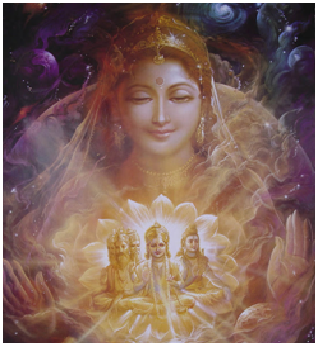
Mahashatiand tridev

Initial universe energy, while slowing down changed its speed of motion. As per basic science

Rate of energy ( E /t) = Force x speed of motion (F x V)

 In this way different types of universal forces emerged.

 UNIVERSAL FORCES

According to the Big Bang theory, a single force existed at the beginning of the Universe, and, as the Universe expanded and cooled, this force separated into

  1. gravity,
  2. electromagnetism, and
  3. the nuclear forces.

Two forces act within the nucleus to hold it together:

  1. the strong nuclear force and
  2. the weak nuclear force.

These are four fundamental forces  are sometimes called universal forces.

  1. The Strong Nuclear Force: The strong nuclear force is a powerful force of attraction that acts only on the neutrons and protons in the nucleus, holding them together. This force works over distances the diameter of a proton. The nucleus of an atom has protons crammed into a tiny space. Protons are positive so they should repel each other. But the protons are held together by a force stronger than the electromagnetic force.
  2. The Weak Nuclear Force: The weak nuclear force is an attractive force that acts only over a short range and affects all particles, not just protons and neutrons. Acts over a distance of about 10-18 meters. It is weaker than the strong nuclear force as well as the electromagnetic force. This force is responsible for nuclear beta decay and other similar decay processes involving fundamental particles. The range of this force is smaller. it is important in understanding the behavior of fundamental particles.
  3. The Electromagnetic Force: Electromagnetic force, which is carried by a particle called the photon. Electromagnetism is several billions times more powerful than the gravitational force. This is the force which exists between all particles which have an electric charge. Electric and magnetic force are two different aspects of the electromagnetic force. Electromagnetic force is associated with charged particles. Electric and magnetic forces are the only forces that can both attract and repel. a) Electric Forces: Electric forces act between charged objects or particles such as electrons and protons. Objects with opposite charges (positive and negative) attract one another. Objects with like charges repel one another. b)Magnetic Forces: Magnetic forces act on certain metals, on the poles of magnets, and on moving charges. Magnets have two poles (North and South) that attract each other. For example, electrons (negative charge) bind with nucleus of an atom, due to the presence of protons (positive charge).
  4. The Gravitational Force: Gravity is the weakest universal force. Gravitational force involves much more than just Earth’s gravitational field. Newton’s law of universal gravitation states that every object in the universe attracts every other object. Gravity acts over large distances. Gravitational force between two objects is proportional to their masses and decreases rapidly as the distance between the masses increases.

UNIVERSAL FORCES AND TRINITY OF GODS

In Indian mythology, the same things have been explained in a very interesting manner. Adishakti created three types of forces in the form of Trinity of Gods. Trinity of Gods Shiva, Brahma and Vishnu are the forms of universal forces: Nuclear forces, Gravitational forces, and Electro-magnetic forces respectively.

  1. Nuclear forces are of two types: Strong nuclear force and weak nuclear force. In the same way the first Trideva Shiva has two forms;  Mahadeva as Strong nuclear force responsible for the stable structure of the atom in the form of beautiful world through Lasya. And the other form Rudra denoting Weak nuclear force responsible for nuclear beta decay and other similar decay processes involving fundamental particles.
  2. Forces of gravitation has created all the planet and stars playing the role of creator of everything, which depicts the another Trideva Bramha.
  3. Every item is maintained and sustained with the strong electromagnetic forces, which is the another Trideva Vishnu.

All gods or devtas are forms of energies. They each go through a phase of transition and play their role in governing some aspect of Creation.

The Universe Energy (Mother Goddess) is primarily the embodiment of Shakti, power or Energy, of growth, fertility and prosperity, or death, destruction and disease. She is the universal mother, the epitome of female power overriding all other powers and primal energy. The Supreme Energy or Maha Shakti is manifested chiefly in three forms: Maha Saraswati, Maha Lakshmi and Maha Kali. The three devis represent three important facets of life: Creation, Conservation and Annihilation. Learning and wisdom play a far more important role than details of one’s birth.

  1. Maha Saraswati stands for creation. The creative person who pursues knowledge and wisdom continues to live with her grace.
  2. Maha Lakshmi, who is responsible for the sustenance of life. Maha Lakshmi bestows her grace and bounty.
  3. Finally, Maha Kali, responsible for annihilation, completes the cycle.

Saraswati, Lakshmi and Maha Kali/Shakti are the three forms of the Goddess. They embody knowledge, wealth and power. Brahma, Vishnu and Shiva are the three forms of God who create, sustain and destroy.  Now observe carefully. The Goddesses are associated with nouns: knowledge, wealth and power. The Gods are associated with verbs: creating, sustaining, destroying. Knowledge/wealth/power can be created/sustained/destroyed. Knowledge/wealth/power provides the capability to create/sustain/destroy. Action is with the Gods — the result of the action is the Goddess who in turn provokes more action.
In this way Three Gods were got wedded with their respective Goddesses. Shiva with Mahakali/Gauri in two different forms; Vishnu with MahaLaxmi, and Bramha with Saraswati.