गीता-गीत GITA GEET तृतीयो अध्याय (श्लोक20-26)Third chapter(Verses 20-26) कर्म पथ

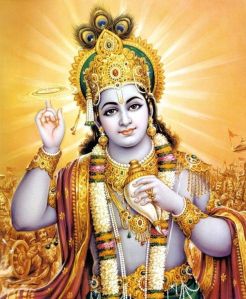
UNIVERSAL GURU LORD KRISHNA 

कृष्णं वन्दे जगद्गुरुम्

गीता-गीत GITA GEET

तृतीयो अध्याय (श्लोक20-26)Third chapter(Verses 20-26)

कर्म पथ

कर्मणैव हि संसिद्धिमास्थिता जनकादयः ।

लोकसंग्रहमेवापि सम्पश्यन्कर्तुमर्हसि ॥3-20॥

कर्म से निश्चय ही संपूर्ण  सिद्धि पाते|

जनक-आदि ज्ञानी जन सफल कहे जाते||

लोक कल्याण के भी दृष्टि से हे अर्जुन!|

                नियत कर्म  करने  आवश्यक  हो जाते||3-20||

Kings like Janaka and others attained the Supreme goal by deeds alone; moreover, even for the maintenance of the world order, you should perform prescribed duties. (3-20)


यद्यदाचरति श्रेष्ठस्तत्तदेवेतरो जनः ।

    स यत्प्रमाणं कुरुते लोकस्तदनुवर्तते ॥3-21॥

जैसा जैसा आचरण श्रेष्ठ जन करते जाते|

वैसा वैसा ही सदा  दूसरे व्यक्ति अपनाते||

जो भी प्रमाणित कर जाते वह इस जग में

                   अन्य लोगों को उनका अनुशरण करते पाते||3-21||

Whatever  noble person does, others also follow the same; the people follow  the standards set by the great persons.(3-21)


न मे पार्थास्ति कर्तव्यं त्रिषु लोकेषु किंचन ।

      नानवाप्तमवाप्तव्यं वर्त एव च कर्मणि ॥3-22॥

अर्जुन! मेरे लिए न कर्त्तव्य कुछ नियत|

 तीनों लोकों में, है न कुछ अप्राप्य-वत ||

न ही कुछ ऐसा, जो मुझे प्राप्त करना|

                   फिर भी सदा रहता मैं, कर्म में ही रत||3-22||

Lord Krishna says to Arjun,  “As a Supreme Energy, there is no duty assigned to fulfil in all the three worlds; neither do I have anything to gain. Even so, I engage myself in action”. Each and every element of the nature is carrying out its duty as assigned by the  Supreme Energy (3-22)


यदि ह्यहं न वर्तेयं जातु कर्मण्यतन्द्रितः ।

            मम वर्त्मानुवर्तन्ते मनुष्याः पार्थ सर्वशः ॥3-23॥

निश्चय ही, यदि मैं हो कर सावधान मन|

     नहीं व्यस्त रहूँ करने कर्मों का सम्पादन||

      अर्जुन! न मनुष्य सब समुचित करेंगे कर्म|

                  सब तरह करें वे सदा मेरा ही अनुगमन||3-23||

If I do not carefully engage in action, people would follow My example in all matters and stop doing their duties.(3-23)


यदि उत्सीदेयुरिमे लोका न कुर्यां कर्म चेदहम्‌ ।

    संकरस्य च कर्ता स्यामुपहन्यामिमाः प्रजाः ॥24॥

ये लोक सब नष्ट हों जायेंगे यदि,

नियत कर्म मेरे ही न हों उचित|

बनूंगा सब के लिए मैं नाश कर्ता,

                   कर इन्हें अवांछित सन्तति सहित||3-24||

If I cease to work, the world would perish; I would be the cause of corrupt and unwanted population, contributing to their destruction.(3-24)


सक्ताः कर्मण्यविद्वांसो यथा कुर्वन्ति भारत ।

            कुर्याद्विद्वांस्तथासक्तश्चिकीर्षुर्लोकसंग्रहम्‌ ॥3-25

आसक्त-जन कर्म में कार्य करते,

जैसे मन में फल की चाहना ले|

वैसे ही आसक्ति रहित विद्वान,

                     करें लोक-कल्याण की कामना ले||3-25||

O Arjuna!  just as ignorant individuals attached to action perform deeds, so also must a wise person  engage in action, with the  spirit of detachment and for the benefit of society as a whole.(3-25)


न बुद्धिभेदं जनयेदज्ञानां कर्मसङि्गनाम्‌ ।

            जोषयेत्सर्वकर्माणि विद्वान्युक्तः समाचरन्‌ ॥3-26

कर्म में आसक्त अज्ञानियों की बुद्धि,

भ्रमित करें नहीं विभिन्न भेद कहकर|

विद्वान सभी कर्मों में उनको लगाएं,

                    स्वयं योगयुक्त, उचित आचरण कर||3-26||

An enlightened person should not create confusion in the minds of those ignorant beings who are attached to action. Performing all actions with equanimity himself, he should induce them into righteous conduct.(3-26) 

LEARNING:

  • Each and every element of the nature is performing its role assigned by the Supreme Energy.
  • Performing the assigned duties is essential for the growth and development of the human-being as a whole .
  • All the great men got success and respect in the world only by their deeds. For the great leaders, it is essential that they should set an example by actions, else others will start going to wrong path and destroy the society.
  • Rituals are associated with every wisdom tradition in the world. There is a lot of meaning and symbolism contained in them. Rituals help us to proceed upon the right path especially in the initial stages.
  • Spiritual practices helps raise our wavelength to connect to the Divine Energy present inside us. If spirituality is high use of rituals is increasingly diminished.
  • Intelligent wise men should not confuse the mind of ordinary persons. They should not stop them to follow their own rituals; otherwise they will stop performing. Rather intellectuals should perform for the welfare of the society and also inspire others to do their duties in the interest of the society.

quickbloging is free guest post site for all niche…

गीता-गीत GITA GEET तृतीयो अध्याय (श्लोक10-19)Third chapter(Verses 10-19) यज्ञ (Sacrifice for the society as a whole)

गीता-गीत GITA GEET

तृतीयो अध्याय (श्लोक10-19)Third chapter(Verses 10-19)

यज्ञ (Sacrifice for the society as a whole)


सहयज्ञाः प्रजाः सृष्टा पुरोवाचप्रजापतिः ।

          अनेन प्रसविष्यध्वमेष वोऽस्त्विष्टकामधुक्‌॥3-10॥

रच कर यज्ञ मनुज के ही संग, देते ब्रम्हा ज्ञान |

       सर्व-हिताय व्यक्तिगत-आहुति, दैवी-यज्ञ विधान ||

     यही यज्ञ मानव समाज के विकास हित सोपान |

                    करे पूर्ण इच्छित अभिलाषा, हो जग में निर्मान ||॥3-10॥


देवान्भावयतानेन ते देवा भावयन्तु वः ।

         परस्परं भावयन्तः श्रेयः परमवाप्स्यथ ॥3-11॥

भाव लोकहित  में देने का, देव-भाव ही जान |

देव भाव की उन्नति से हो देवों का सम्मान ||

प्रकृति रहे संतुलित, देव-भाव की यह पहचान |

             एक दूसरे की उन्नति से, हो सबका कल्यान ||॥3-11॥


इष्टान्भोगान्हि वो देवा दास्यन्ते यज्ञभाविताः ।

         तैर्दत्तानप्रदायैभ्यो यो भुंक्ते स्तेन एव सः ॥3-12॥

इच्छित भोग तुम्हें देंगे सब देव वहाँ |

यज्ञ भाव से प्रेरित-कर्म आचरित जहां||

स्वयं ही केवल देव-प्रदत्त भोगते भोग |

               जो, वह चोर स्वभाव, यही कहेंगे लोग||3-12||


यज्ञशिष्टाशिनः सन्तो मुच्यन्ते सर्वकिल्बिषैः ।

     भुञ्जते ते त्वघं पापा ये पचन्त्यात्मकारणात्‌ ॥3-13॥

यज्ञ संपन्न कर के, लेते जो  प्रसाद शेष|

   सर्वदोष मुक्त संत, बनते हैं वही  विशेष||

     परन्तु, इन्द्रिय-सुख के हेतु करें जो कार्य|

                 घोर पाप भोगते वह, स्वयं धरे पाप-वेष||3-13||


अन्नाद्भवन्ति भूतानि पर्जन्यादन्नसम्भवः ।

             यज्ञाद्भवति पर्जन्यो यज्ञः कर्मसमुद्भवः ॥3-14॥

कर्म ब्रह्मोद्भवं विद्धि ब्रह्माक्षरसमुद्भवम्‌ ।

          तस्मात्सर्वगतं ब्रह्म नित्यं यज्ञे प्रतिष्ठितम्‌ ॥3-15॥

सब प्राणी अन्न से, अन्न बादल बरसने से|

बादल यज्ञ से, यज्ञ जन-हित कर्म करने से||

कर्म ज्ञान से हो, ज्ञान ब्रम्ह-अक्षर से संभव|

                    सर्व-व्याप्त ब्रम्ह, नित्य यज्ञ-स्थित रहने से||3-14,15||


एवं प्रवर्तितं चक्रं नानुवर्तयतीह यः ।

      अघायुरिन्द्रियारामो मोघं पार्थ स जीवति ॥3-16॥

इस प्रचलित चक्र के अनुसार जो नहीं चलते|

अपने कर्तव्यों का अनुपालन जो नहीं करते||

केवल इन्द्रियों-भोगों में रमण करने वाले लोग|

               पाप-आयु, आत्म-केन्द्रित व्यर्थ ही जीते रहते||3-16||


यस्त्वात्मरतिरेव स्यादात्मतृप्तश्च मानवः ।

     आत्मन्येव च सन्तुष्टस्तस्य कार्यं न विद्यते ॥3-17॥

लेकिन जो मानव, आत्मा में करते हैं रमण |

आत्मतुष्ट हुए अंतरात्मा में करते जो भ्रमण ||

आत्म-ज्ञान से ही रहते हैं प्रकाशित वह सदा|

          उनके लिए नहीं कार्य शेष जो कर सकें ग्रहण॥3-17॥


नैव तस्य कृतेनार्थो नाकृतेनेह कश्चन ।

        न चास्य सर्वभूतेषु कश्चिदर्थव्यपाश्रयः ॥3-18

उनके करने का, न ही कुछ अर्थ है|

               नहीं करने से, न इनका  अनर्थ है ||

   सभी-प्राणियों में न है आश्रय इनका ,

                स्वार्थ-सम्बन्ध न, यह स्वयं समर्थ है||3-18||


            तस्मादसक्तः सततं कार्यं कर्म समाचर ।

                       असक्तो ह्याचरन्कर्म परमाप्नोति पुरुषः ॥3-19॥

            अतः बिन आसक्ति सदा नियत-कर्म कार्य कर |

                            अनासक्त आचरण से ही पहुंचें पुरुष कर्म-शिखर ||3-19||

The design of human-being is such that each and everyone is dependent on other’s contribution right from the beginning. So, for the welfare of this race, spirit of sacrifice is necessary in each and every human-being. The spirit of sacrifice has been termed as YAGYA.

In the beginning, after creating the mankind  along with  spirit of sacrifice (Yagya), the Creator said to  human-being, “By this spirit of sacrifice for all others” (i.e.yagya) may you prosper and multiply! May this yagya yield the  enjoyment you seek and fulfill you and your coveted desires.”(3-10).

You may cherish gods by yagya and may gods foster you, for this is the means by which you will finally achieve the ultimate state. Nourish the Devas through this yagya and may those Gods nourish you. Thus through mutual satiation, both shall attain the highest good.(3-11)

The gods you foster by yagya will shower upon you without asking all the joys you wish for, but the man who avails himself of these joys without having paid for them is truly a thief.(3-12)

The wise who partake of what is left over from yagya are rid of all evil, but the sinners who cook only for the sustenance of their bodies partake of nothing but sin. (3-13)

Krishna says it is this spirit of offering or yajna which harmoniously moves the cosmic wheel. The sun offers itself to form clouds after taking water as  offering of Yagya, clouds offer themselves to form rain, rains offer themselves to grow food. In this manner, all members of the universe offer themselves at the altar of the macrocosm and thereby help move the cosmic wheel. All living bodies subsist on food grains, which are produced from rains. Rains are produced by performance of yajna [sacrifice], and yajna is born of prescribed duties. (3-14)

The duties of humans have been laid down by God himself. Since it is the collective experiences of experienced great men, so it is mentioned here that the Vedas are manifested by God himself. To give importance it is said that the all-pervading Lord is eternally present in acts of sacrifice.(3-15)

The man in this world, O Parth, who loves sensual pleasure and leads a sinful life; i.e. does not perform his duties, and does not conduct himself in accordance with the thus prescribed cycle. He lives in vain.    No individual is a separate entity. “A person who fails to fulfil his obligations in this Cycle of Creation leads a wretched, sinful and wasteful life” ॥3-16॥

But, for a person who takes delight only in the self, is satisfied with the self and content in the self alone, verily there is no further work to be done by him. (3-17)

For the person who is thus rejoicing in the Self does not gain anything by doing any action. For him really no purpose is served by an action. He does not lose anything from inaction. He need not depend upon anybody to gain a particular object. He need not exert himself to get the favour of anybody. Nor does such a person depend on any being for any object whatsoever.(3-18)

Therefore without attachment, one should act as a matter of duty; for by performing action without attachment one attains the Supreme.(3-19)

Learning:

Interdependence in the world: All our actions, however small or insignificant, do have an effect on the entire world. What ever a man is enjoying today that is not his creation only but the contribution of other generations before. Even a single thoughtless comment can cause alienation.  Let us then begin viewing the world from the enlightened perspective of interdependence. So, we all are required to contribute further to maintain continuity of development.

  1. Spirit of offering (or yajna): The entire universe is a cosmic wheel of action set in motion by spirit of ‘yajna’. If nature does not work in the spirit of sacrifice then life would come to stand still.
  2. No place for personal desire: Personal desires have to be sacrificed for the benefit of the larger society aiming at the happiness for all. Yagya is an Act of contributing for the society as a whole. Any action that is beneficial to society is called Yajna. It is sharing and cooperating through that one can find the way to selflessness, which in turn benefits the entire community. When an organizations fails, it is only because of lack of cooperation and misunderstanding among the members. The spirit of sacrifice for the great causeWhen there is no team spirit.
  3. Be egoless: The spirit of yajna involves giving up our sense of’ ‘I’ and ‘mine’, our ego and selfishness, and endeavour to grow thru joint efforts. During the conventional yagya (HAVAN), also one chants mantra IDAM NA MAM after each SWAHA. Or we say ‘what we sacrificed does not belong to me.’
  4. Everybody is a role-player: One should lead a healthy life to liberate himself from the clutches of materialism. Every action can become a yagya once we understand the spirit of it.Everybody is assigned a certain role in life. May that role be performed to the best of one’s ability, for the well-being of the macrocosm. All duties and actions that one has to perform may be looked upon as an opportunity to serve the universe.
  5. The human being is indebted to each and every member of the universe such as elements, trees, animals, sages, parents, teachers, ancestors and scientists for what he is today. One who enjoys favours from the universe but does not return those favours, is a thief. Also, if one wishes only to accept happiness alone instead of sharing with others, he can be considered as selfish and as low as thief.

Eco-Friendly Environment (Man & Nature) : When we pollute air by smoke, rivers by throwing garbage, and we waste water we destroy Nature and harm ourselves. If Nature becomes weak, we, too, are adversely affected. These actions are self-destructive. Man has no alternative but to perform yajna by planting trees, saving water, recycling resources and respecting the environment.
We can thus either contribute to the harmony of the cycle or bring about discord in the smooth running of this cosmic mechanism. When the majority of the people of human society accept their responsibility to live as integral parts of the universal system, material prosperity abounds and spiritual growth is engendered. Conversely, when a major section of humankind begins to violate the universal system and rejects its responsibility as an integral part of the cosmic system, then material nature begins to punish, and peace and prosperity become scarce.

गीता-गीत Gita-geet तृतीयो अध्याय (श्लोक1-9)Third chapter(Verses 1-9) कर्मयोग का महत्व

गीता-गीत Gita-geet

तृतीयो अध्याय (श्लोक1-9)Third chapter(Verses 1-9)

कर्मयोग का महत्व

अर्जुन उवाच

ज्यायसी चेत्कर्मणस्ते मता बुद्धिर्जनार्दन ।

    तत्किं कर्मणि घोरे मां नियोजयसि केशव ॥3-1

व्यामिश्रेणेव वाक्येन बुद्धिं मोहयसीव मे ।

      तदेकं वद निश्चित्य येन श्रेयोऽहमाप्नुयाम्‌ ॥3-2॥॥

मानते हो बुद्धि को यदि कर्म से बेहतर|

डालते हो इस भयंकर कर्म में क्यों कर ||

अनेकार्थक वचन से अब बुद्धि मोहित है|

                बोल दो निश्चित मेरे हित जो भी श्रेयस्कर||3-1,2||


श्रीभगवानुवाच

लोकेऽस्मिन्द्विविधा निष्ठा पुरा प्रोक्ता मयानघ ।

ज्ञानयोगेन साङ्‍ख्यानां कर्मयोगेन योगिनाम्‌ ॥3-3

दो प्रकार की निष्ठायें, माने यह संसार |

जाने साङ्ख्य योग से प्रकृति-पुरुष व्यापार||

कर्म-योग से ज्ञात हो नियत कर्म विस्तार|

                 करें लोक-हित कर्म सब, बिन-फल-में-अधिकार||3-3||

न कर्मणामनारंभान्नैष्कर्म्यं पुरुषोऽश्नुते ।

     न च सन्न्यसनादेव सिद्धिं समधिगच्छति ॥3-4

अनारम्भ कर्म से पुरुष, न निष्कर्मता को पा जाता|

             संन्यास ले लेने से ही न वह, सफल कहीं हो पाता||3-4||


न हि कश्चित्क्षणमपि जातु तिष्ठत्यकर्मकृत्‌ ।

कार्यते ह्यवशः कर्म सर्वः प्रकृतिजैर्गुणैः ॥3-5

बिना कर्म के किये नहिं रह सकते क्षण-मात्र|

संभव नहीं चला सकें बिना कर्म निज गात्र ||

तामस-राजस-सत्व गुण प्रकृति-जन्य ही जान|

             इन्हीं गुणों से विवश सब कर्म करें यह मान||3-5||

कर्मेन्द्रियाणि संयम्य य आस्ते मनसा स्मरन्‌ ।

   इन्द्रियार्थान्विमूढात्मा मिथ्याचारः स उच्यते ॥3-6

कर्मेन्द्रियां संयमित कर, रोके हठ से अंग|

याद करे इन्द्रिय-विषय, हो मन उनके संग||

यह है स्वयं ही स्वयं को, मूर्ख बनाता ढंग|

             उसे कहें मिथ्याचारी, हों जिसके झूठे रंग ||3-6||


यस्त्विन्द्रियाणि मनसा नियम्यारभतेऽर्जुन ।

   कर्मेन्द्रियैः कर्मयोगमसक्तः स विशिष्यते ॥3-7

किन्तु नियंत्रित इन्द्रियाँ मन के द्वारा कर |

अनासक्त, कर्मेन्द्रियों से आरम्भ कर जो नर||

कर्मयोग हित, वह ही बनता व्यक्ति विशेष |

           हे अर्जुन उसके लिए नहिं करना कुछ शेष ||3-7||


नियतं कुरु कर्म त्वं कर्म ज्यायो ह्यकर्मणः।

  शरीरयात्रापि च ते न प्रसिद्धयेदकर्मणः ॥38

करो कर्म जो है यहाँ नियत तुम्हारे हेतु |

सदा कर्म, अकर्म से श्रेष्ठ है जीवन सेतु ||

कर्मों से सिद्धि मिले, यह जीवन का मर्म|

            शरीर के निर्वहन हित भी करते  नित कर्म ||3-8||


यज्ञार्थात्कर्मणोऽन्यत्र लोकोऽयं कर्मबंधनः ।

  तदर्थं कर्म कौन्तेय मुक्तसंगः समाचर ॥3-9॥

यज्ञ है समष्टि को सहज समर्पित कर्म |

अन्यत्र कर्मों  से जुड़ें बंधन कारक मर्म ||

इसीलिये हे अर्जुन! बिना किसी आसक्ति |

           कर्म करो जैसा उचित आचरणीय स्वधर्म ||3-9||

After listening to the Lord’s teaching in the second chatper, Arjuna gets a doubt regarding the role of karma yoga and that of jnana yoga.  Arjuna thinks that there is a choice between karma yoga and jnana yoga and a person can choose any one of these. So, he seeks clarification from Lord Krishna.

Arjuna’s question asking the Lord “If knowledge is superior to karma then why do you push me into karma?”(3-1)

“With this apparently perplexing speech you confuse my understanding ; therefore , tell me that one way for certain by which I may attain the highest”.(3-2)

Krishna replied stating as follows:

In this world there is a two-fold path, One is an exclusive pursuit of knowledge. This is called sāṅkhya or jñāna-yoga.

A second lifestyle is performing the duties and roles assigned for him after acquiring full knowledge ( called karma-yoga). In this world, these two types of committed life styles were taught by me(Krishna) earlier,(3-3)

A status where no further action is required (Naishkarmyam) and perfection (Siddhi) of action are synonymous.  If a man simply sits quiet by abandoning action , he cannot say that he has attained to the state of perfection where no further action is required. No one can reach perfection or freedom from action or knowledge of the Self by mere renunciation or by simply giving up activities without possessing the knowledge of the Self.(3-4)

Mere abstinence from work does not result in a state of freedom from karmic reactions. The mind continues to engage in thoughts, planning, scheming and speculating.  Since mental work is also a form of karma, it binds one in karmic reactions, just as physical work does. One cannot attain perfection of knowledge by mere physical renunciation.(3-5)

One who restrains the senses of action but whose mind dwells on sense objects certainly deludes himself and is called a pretender. (3-6)

O Arjuna!, one, who engages in Karma-yoga with the organs of action, controlling the organs with the mind and becoming unattached with the outcome, excels in performing the action. (3-7)

Perform your prescribed duty, because action is better than inaction. A man cannot even maintain his physical body without doing some routine work. (3-8)

Man is bound by his own action except when it is performed for the sake of sacrifice for the society as a whole, termed as YAGYA. Therefore, O son of Kunti, be unattached and do your duty for the sake of sacrifice i.e. yagya.(3-9)

Learning:

  • Nishtha (or life style) is either one value or a set of values, that you adopt to govern all your activities and pursuits in life. If you are a nishthaavaana, then you will always find, the mind, the intelligence, the will, everything in you, is governed by the nishtha values. You will always be wanting to ensure that whatever you do, think, and speak has one set of values

There are two types of life style or  nishtha:

  1. Pravrithi marga, an active life in society, which is pravrithi marga.
  2. Nivrthi marga, a life of withdrawal, a life of sanyasa ashrama.

Karm-yoga comes under Pravrithi marga: take to active way of service, contributing          to the society and in the process refine the mind;

  • Shree Krishna declares that the sānkhya yogi cannot attain the state of knowledge merely by renouncing the world and becoming a monk. By avoiding action, a person does not attain liberation from the results of past Karma. One may give up the physical objects of the senses, Out of previous habit, the materially contaminated mind keeps running in the direction of anxiety, stress, fear, hatred, envy, attachment, and the whole gamut of material emotions.
  • Therefore, action is also necessary for success in sānkhya yog. In this world, no man can rest without doing work; for every person, even though he may have determined, ‘I will not do anything,’ is caused to act, i.e., is compelled to act according to the Gunas born of Prakrti.
  • Everyone is compelled to act according to the Gunas born of Prakrti. The Gunas are Sattva, Rajas and Tamas; which increase in accordance with his old Karma. Consequently, Jnana Yoga can be attained only by means of a purified inner organ after annulling the old accumulation of sins by means of Karma Yoga of the aforesaid characteristics and bringing Sattva and other Gunas under control. Otherwise, one who engages oneself in Jnana Yoga becomes a hypocrite:
  • Sattva is harmony or light or purity; Rajas is passion or motion; Tamas is inertia or darkness. Sattvic actions help a man to attain to Moksha. Rajasic and Tamasic actions bind a man to Samsara. These qualities cannot affect a man who has knowledge of the Self. He has crossed over these qualities. He has become a Gunatita (one who has transcended the qualities of Nature). The ignorant man who has no knowledge of the Self and who is swayed by Avidya or nescience is driven helplessly to action by the Gunas.
  • The only difference in the human beings is the proportion of the three gunas; satva pradhana, raja pradhana, or tama pradhana, in accordance with his old Karma. So, nobody can remain inactive for even a moment. Otherwise, one who engages oneself in Jnana Yoga becomes a hypocrite: the more you give up physical action, the mind becomes proportionately doubly active. Mind is not meant for stopping but for functioning.
  • Some people think that action refers only to professional work, and not to daily activities such as eating, drinking, sleeping, waking and thinking. So when they renounce their profession, they think they are not performing actions. But Shree Krishna considers all activities performed with the body, mind, and tongue as actions. Hence, he tells Arjun that complete inactivity is impossible even for a moment. If we simply sit down, it is an activity; if we lie down, that is also an activity; if we fall asleep, the mind is still engaged in dreaming; even in deep sleep, the heart and other bodily organs are functioning. Thus Shree Krishna declares that for human being’s inactivity is an impossible state to reach, since the body-mind-intellect mechanism is compelled by its own make-up of the three guṇas (sattva, rajas, and tamas) to perform work in the world.
  • Therefore, it is impossible to give up action; maximum you can do is to reduce or redirect the action; in karma yoga.
  1. Inaction in action (कर्म में अकर्म): Though engaged physically in intense action, but the idea of agency performing the action, is absent, i.e.if one feels that Prakriti does everything, it is inaction in action.
  2. Unattached action (निष्काम कर्म): If one is free from attachment and is always calm and serene though engaged in ceaseless action, he is unaffected by the pairs of opposites like joy and grief, success and failure. Also, one who has true union with the Supreme is not subject to rebirth. He attains immortality. Such a union can only be achieved when one is free from attachment, fear and anger, being thoroughly purified by right knowledge.
  • Man is bound by his own action except when it is performed for the sake of sacrifice for the society as a whole, termed as YAGYA. Any selfless action or action imbued with the spirit of reaching out is what is meant by the word yajna. Since the conduct of yagya is the only action that is not directed for self. All other business in which people are engaged are only forms of worldly bondage,

‘NAV-DURGA’ AN INDIAN PHILOSOPHY FOR SYNERGY AND CORPORATE-POWER ‘नव दुर्गा’ सह-शक्ति व निगम-शक्ति का भारतीय-दर्शन

 ‘NAV-DURGA’ AN INDIAN PHILOSOPHY FOR  SYNERGY AND

CORPORATE-POWER

‘नव दुर्गा’ सह-शक्ति व निगम-शक्ति का भारतीय-दर्शन    

सन्देश नवदुर्गा का यह, सह-शक्ति का सम्मान हो |

न कहीं-कभी-किसी-भी पल निज-शक्ति पर अभिमान हो||


आभा त्रिदेव की मिली बन दुर्गा स्वरूप में आगई |

देवों को जिसने हरा दिया, सह-शक्ति उसको हरा गई||

पाओगे तुम हर लक्ष्य यदि सहयोग-शक्ति का भान हो|

सन्देश नवदुर्गा का यह, सह-शक्ति का सम्मान हो ||


तन दिया माता पिता ने, मन संस्कारों से बना |

जो भी है प्रकृति, समाज का, क्यों अन्य को करें मना||

लाये न कुछ अपना यहाँ, कारण है क्या, गुमान हो |

सन्देश नवदुर्गा का यह, सह-शक्ति का सम्मान हो ||


जो स्वयं से संभव नहीं हो, सहयोग लेते अन्य का

निर्माण करते निगम, जो सामर्थ्य दे सहशक्ति का

निज लक्ष्य पा सकते, निगम-प्रबन्ध का यदि ज्ञान हो|

सन्देश नवदुर्गा का यह सह-शक्ति का सम्मान हो ||


शरीर भी एक दुर्ग और निगम भी है एक दुर्ग सम |

नियम बद्ध चलें तो दोनों स्वस्थ सदा सफल हों हम||

अनुरूप वातावरण के, बदलें नियम, अभियान हो |

सन्देश नवदुर्गा का यह सह-शक्ति का सम्मान हो ||

SYNERGY (सह-शक्ति): Synergy is a state in which two or more agents, entities, factors, or substances work together in a particularly fruitful way that produces an effect greater than the sum of their individual effects. Thus, Synergistic effect means creation of a whole that is greater than the simple sum of its parts. When something is synergistic, it means various parts are working together to produce an enhanced result. The Synergistic effect has been explained in interesting way through indian mythology.

Durga and Synergy: Synergy usually arises when two or more persons with different complementary skills cooperate. There is a story that the gods were defeated by the demons headed by Mahishasura.

A great light, issued from Vishnu, Shiva, Brahma and other gods joined together, From their joint energies, emerged a unique radiance that took female form, Devi Durga. Her face was formed by Shiva’s light, her hair by Yama’s colour, her arms from Vishnu’s lustre and her breasts from Chandra’s luminescence. From Brahma’s glow came her feet, from Kubera’s her nose and from Agni’s blaze her three eyes.

Shiva gave her his trident, Vishnu his discus, Varuna a conch, Agni a spear, Indra a thunderbolt, Surya bestowed his own rays on all the pores of her skin and Kala (time) gave her a sword and shield. Armed by the gods, the Devi challenged the demons..

In business also, cooperation of people with organizational and technical skills happens very often. In general, the most common reason why people cooperate is that it brings a synergy. People tend to specialize just to be able to form groups with high synergy.

A corporate synergy refers to a financial benefit that a corporation expects to realize when it merges with another unit.

Durga and Corporate World: A corporate is a company or group of people authorised to act as a single entity and recognised as such in law. As per the mythology from the joint energies of Vishnu, Shiva, Brahma and other gods,  emerged a unique radiance that took female form, Devi Durga. Thus Goddess Durga can be considered as the manifestation of the corporate world formed by all the Gods in a single entity Durga.

The word Durga is rooted in the word durg, which refers to a fortress that we build to protect ourselves from marauders. Durga, in the corporate world, is the psychological fortress we build by making system and get them audited regularly to cope with the corporate world.

Corporations are owned by their stockholders (shareholders) who share in profits and losses generated through the firm’s operations, and have three distinct characteristics

  • Legal existence: a firm can (like a person) buy, sell, own, enter into a contract, and sue other persons and firms, and be sued by them. It can do good and be rewarded, and can commit offence and be punished.
  • Limited liability: a firm and its owners are limited in their liability to the creditors and other obligors only up to the resources of the firm, unless the owners give personal-guaranties.
  • Continuity of existence: a firm can live beyond the life spans and capacity of its owners, because its ownership can be transferred through a sale or gift of shares.

The corporate world is voluntary submission to a system of rules, practices and processes by which a company is directed and controlled. Corporate governance essentially involves balancing the interests of the many stakeholders in a company – these include its shareholders, management, customers, suppliers, financiers, government and the community.

GITA Chapter 2 (62-72) गीता द्वितीय-अध्याय श्लोक(62-72) स्थितप्रज्ञ की विधि – ‘इन्द्रिय-निग्रह’ (Technique to achieve stability of mind – ‘Control of senses’)

GITA Chapter 2 (62-72)

गीता द्वितीय-अध्याय श्लोक(62-72)

स्थितप्रज्ञ की विधि – ‘इन्द्रिय-निग्रह’

 (Technique to achieve stability of mind – ‘Control of senses’)

ध्यायतो विषयान्पुंसः संगस्तेषूपजायते ।

         संगात्संजायते कामः कामात्क्रोधोऽभिजायते ॥2-62

हो जिस विषय पर ध्यान, उससे ही तो हो आसक्ति |

          पूरी न हो यदि कामना, फिर  क्रोध की उत्पत्ति ||2-62||

क्रोधाद्‍भवति सम्मोहः सम्मोहात्स्मृतिविभ्रमः ।

स्मृतिभ्रंशाद् बुद्धिनाशो बुद्धिनाशात्प्रणश्यति ॥2-63

क्रोध से सम्मोह, फिर हो भ्रमित, शक्ति स्मरण की |

                नाश हो बुद्धि का, भ्रष्ट स्मृति से, गति हो मरण की||2-63||

रागद्वेषवियुक्तैस्तु विषयानिन्द्रियैश्चरन्‌ ।

         आत्मवश्यैर्विधेयात्मा प्रसादमधिगच्छति ॥2-64

  राग-द्वेष रहित विषय में इन्द्रियों का हो भ्रमण|

                  आत्म-वस मन शांत कर दे, स्वनियंत्रित आचरण||2-64||

प्रसादे सर्वदुःखानां हानिरस्योपजायते ।

              प्रसन्नचेतसो ह्याशु बुद्धिः पर्यवतिष्ठते ॥2-65

ऐसी प्रशन्नता से ही सब दुखों का अभाव हो|

           प्रशन्नचित्त में ही स्थिर बुद्धि का प्रभाव हो||2-65||

नास्ति बुद्धिरयुक्तस्य न चायुक्तस्य भावना ।

न चाभावयतः शान्तिरशान्तस्य कुतः सुखम्‌ ॥66

बुद्धियोग बिना    न निश्चय-बुद्धि,    न ही भावना|

                    भावना-बिन हो न शान्ति, अशान्त बिन-सुखकामना||2-66||     

इन्द्रियाणां हि चरतां यन्मनोऽनुविधीयते ।

तदस्य हरति प्रज्ञां वायुर्नावमिवाम्भसि ॥2-67

इन्द्रियों में जिस किसी के संग करता मन रमण |

               वही करती, वायु जल में नाव सम, बुद्धि-हरण ||2-67||

तस्माद्यस्य महाबाहो निगृहीतानि सर्वशः ।

               इन्द्रियाणीन्द्रियार्थेभ्यस्तस्य प्रज्ञा प्रतिष्ठिता ॥2-68

अतः विषयों से पृथक हो, इन्द्रिय नियंत्रित रहें|

                   जिसकी सब प्रकार, बुद्धि उसकी प्रतिष्ठित कहें ||2-68||

या निशा सर्वभूतानां तस्यां जागर्ति संयमी ।

      यस्यां जाग्रति भूतानि सा निशा पश्यतो मुनेः ॥२-69

संयमी जिस ज्ञान में रहते हैं जागृत,

उससे अनजान दुनिया रात मान सोती

सभी-प्राणी भौतिक सुखों के हित जागते,

            मुनियों की दृष्टि में वह रात ही होती ||2-69||

आपूर्यमाणमचलप्रतिष्ठं-

समुद्रमापः प्रविशन्ति यद्वत्‌ ।

तद्वत्कामा यं प्रविशन्ति सर्वे

        स शान्तिमाप्नोति न कामकामी ॥२-70

सब तरफ़ से जल समुद्र में समा जाते,

जलधि  परिपूर्ण प्रतिष्ठित रहते अचल|

उसी तरह भोग-कामना से शान्ति नहीं,

                 शान्ति वहीं, भोगों से भी रहें अविचल||2-70||

विहाय कामान्यः सर्वान्पुमांश्चरति निःस्पृहः ।

निर्ममो निरहंकारः स शान्तिमधिगच्छति ॥२-71

छोड़ सब कामनाएं बिना आकान्क्षाएं जो विचरता|

            निर्मम अहंकार रहित हो, वह शान्ति प्राप्त करता ||2-71||

एषा ब्राह्मी स्थितिः पार्थ नैनां प्राप्य विमुह्यति ।

    स्थित्वास्यामन्तकालेऽपि ब्रह्मनिर्वाणमृच्छति ॥2-72

अर्जुन! यही है आध्यात्मिक स्थिति

न हो मोहित कभी भी इसमें जा कर

ब्रम्हनिर्वाण पद  को  प्राप्त करता

                 अंत समय भी इस-स्थिति को पाकर||2-72||

Those whose attention is  always about sensual objects, get attached to those objects. Attachment arouses desires and when one does not get what one desires, irritation is aroused, and from irritation stems anger and frustration. (2-62)

From anger, stems delusion (false beliefs or assumptions); delusion causes loss of one’s confused mind; the confused mind makes a person lose his/her ability to reason and lose their power to solve his/her problems. When one loses his/her power to reason, the person will suffer ultimate death and destruction. (2-63)

But the disciplined wise man (Karmayogi) who has control over his senses, enjoys all the sense-objects but remains free from attraction and emotional distractions. Such a person  gains peace and purity of the self. (2-64)

One who can control his senses by practicing the regulated principles of freedom from attachment, attains purity of self and gets rid of all miseries and grief. A person with internal purity soon develops steady wisdom and a clear, unclouded intelligence. (2-65).

One who cannot control his senses is the one who is lacking in steady wisdom and intelligence, and also lacks proper feelings or sentiments (thoughts). A person who cannot think properly and make decisions with a clear mind, cannot have peace of mind, and without peace of mind there can be no happiness. (2-66)

The mind of those who run after or pursue material pleasures and sensual objects, is often clouded and let on the wrong path. His attached mind will distract the intellect in the direction of the sensual pleasure, just as the wind blows away the boat floating on the water. (2-67)

Therefore with senses under control and distracted from sensual objects, one does  have the ability to reason out properly. He also gains peace of mind leading to eternal bliss and happiness. (2-68)

When it is night for all others, i.e. when all beings are not able to see the reality (out of ignorance they are not awakened),the wise man is always awake (spiritually). When others are involved in the sensual pleasure, and deceived (deluded) by sensual objects i.e. when all being are awake in the world of desires, the wise man who knows the truth and has realized God, shuts his eyes to daylight and the misleading material objects that attract other people, and considers it night. He is not easily deceived. (2-69)

As the river enters the ocean without affecting the ocean or disturbing it, so the desires enter the person who has obtained Supreme peace and does not disturb him, but not the person who is already filled with desires and wants more and more. Wiseman becomes the ocean itself, undisturbed by the rivers of information flowing into him from all sides. (2-70)

By giving up all desires, freeing oneself of all attachments and without constantly thinking of oneself or of one’s possessions, only then, one may live in realistic peace. (2-71)

O ARJUNA, this is the state of a person who has truly realized God. After obtaining Supreme Bliss by realizing God, this person cannot be deceived by any of life’s evils. Until the time of death one remains firm in this state and ultimately achieves Supreme Peace and tranquillity. (2-72)

 LEARNING:

  1.    One may enjoy all worldly pleasure but without being attached. One becomes       emotionally attached, if he pays undue attention with the sensual pleasure. Don’t pay attention to sense objects. Never under-estimate the strength of ‘kam, krodh. Lobh, moh and ahankar’- lust, anger, greed, excessive attachment and ego- which are enemies that must be vanquished in order to advance towards our goal.
  2. Biology tells us that your emotions are chemicals, and these chemicals are released by the brain. We control these chemicals. However, over time, these chemicals can change you and control you. The emotions not only rewire your brain, but they also rewire your body. The cells lose the capacity to absorb nutrients. They grow less and they rejuvenate less. Thus, your entire cellular and DNA structure can be changed by your behaviour.
  3. It is the attachment that create desire; and if the desire is not fulfilled, anger overpowers him.
  4. In the state of anger, you are literally poisoning your system. It can be verified by your blood test. Your system turns toxic. Your very chemistry is altered.
  5. Individuals who had trouble controlling expressions of anger were four times likelier to need more than four days for their wounds to heal, compared with counterparts who could master their anger.
  6. Anger increases blood pressure, heart beat rates and adrenalin levels.
  7. Experts say it’s because anger triggers an excessive release of stress hormones, increased oxygen demand by the heart’s muscle cells and causes platelets (which are the blood cells that form clots) to get sticky causing blockage and a heart attack.
  8. Try to be a Man-of-Steady-Wisdom: Characteristics of a person with steady wisdom (stable mind) are as follows:
  • Sthithprajana person speaks the truth yet does not hurt anyone’s feelings; that he does not bring an illusory pleasure through flattery.
  • The stithaprajna is stable: he is not prey to random gusts of passion but sticks to righteous behaviour, having overcome all desires.
  • At the same time, he does not surrender himself to inertia or inactivity but throws himself into action;
  • he is not driven by the psychological burden of the goal, but rather by the imperative of effort.
  • Since he is nishkama, without desire, he is neither shattered by failure nor elated by success.
  • To him, victory and defeat, pleasure and pain, honour and dishonour, friend and enemy are all alike -he judges himself, not by the fickle opinions of others, but by whether or not he has fulfilled his dharma, the ethical path that he has laid down for himself.

The Lord also indicates to Arjuna the practical method, by which he should struggle hard, in order to reach the eminence of perfection as a Man-of-Steady-Wisdom.

We come across some loss in life; whether it is loss of a relationship, material possession, societal status, job opportunity , or a project, it is ignorance to slip into remorse or come up with bargaining measures to undo the loss. Our pain is not real but emanates from our attachment to ego and its inconsequential desires.

  1. When desires are getting fulfilled and our ego is feeling great, there is elation, and
  2. when it turns the other way , there is deep depression.

Our simplistic solution to this complex problem is not to seek to fulfill our desires and pamper our ego which gives all the power to loss because we cannot deal with non-fulfillment of desire.

When you pay attention to fulfill your desire, there will always be unhappiness. If we get what we desire, there is craving for more and if desires are unfulfilled, it leads to anger and frustration. Anger give rise to delusion, delusion to confusion of memory and confusion of memory to loss of intellect.

When intellect is lost, beings form perishes. The eternal self then leaves the body with senses and mind and goes to a new one. One who steadies his intellect will not perish or change the body. He will become non perishable being and may dwell in the same body

If we cultivate mindfulness towards non-fulfillment of desire, the curse of loss turns into a boon of transcendence.

Once we capitalize on this enlightened attitude to give up obsessive desire for gratification and possession, loss becomes a trivial incident rather than a life-defining negative experience.

With practice, the consequent mental state reflects the abode of eternal peace. Then, when confronted with life’s circumstances ­ whether positive or negative ­ we experience neither exultation nor depression but remain balanced and detached.

GITA-GEET गीता-गीत GITA Chapter 2 (54-61) गीता द्वितीय-अध्याय श्लोक(54-61)

GITA-GEET गीता-गीत

GITA Chapter 2 (54-61) गीता द्वितीय-अध्याय श्लोक(54-61)

स्थित प्रज्ञ (PERSON OF STABLE MIND)

अर्जुन का प्रश्न

स्थितप्रज्ञस्य का भाषा समाधिस्थस्य केशव ।

            स्थितधीः किं प्रभाषेत किमासीत व्रजेत किम्‌ ॥2-54

स्थिरबुद्धि समाधिस्थ के क्या लक्षण, कहते हैं  |

              केशव!  कैसे बोलते,  बैठते,  कैसे वे  चलते हैं ||२-54||

कृष्ण-वचन

प्रजहाति यदा कामान्‌ सर्वान्पार्थ मनोगतान्‌ ।

आत्मयेवात्मना तुष्टः स्थितप्रज्ञस्तदोच्यते ॥2-55

मन में आई सब कामनाएं त्याग, सदा  रहते हैं |

                  अपने में संतुष्ट, जो स्थिर बुद्धि उन्हें कहते हैं ||2-55|| 

दुःखेष्वनुद्विग्नमनाः सुखेषु विगतस्पृहः ।

          वीतरागभयक्रोधः स्थितधीर्मुनिरुच्यते ॥2-56

दुःख में मन उद्विग्न नहीं, न सुख में कोई चाहत |

             स्थिर बुद्धि वही जिसको, भय राग क्रोध से राहत ||2-56||

यः सर्वत्रानभिस्नेहस्तत्तत्प्राप्य शुभाशुभम्‌ ।

    नाभिनंदति न द्वेष्टि तस्य प्रज्ञा प्रतिष्ठिता ॥2-57

सभी जगह स्नेहयुक्त हों शुभ हो या फिर अशुभ रहे |

               न अभिनन्दन न द्वेष करें, उसको ही स्थिर बुद्धि कहें||2-57||

यदा संहरते चायं कूर्मोऽङ्गनीव सर्वशः ।

             इन्द्रियाणीन्द्रियार्थेभ्यस्तस्य प्रज्ञा प्रतिष्ठिता ॥2-58

कछुआ समस्त अंग समेट, पीठ की ढाल बना रहता |

              विषयों-से-समेट इन्द्रियों को स्थिर-बुद्धि वही करता ||2-58||

विषया विनिवर्तन्ते निराहारस्य देहिनः ।

      रसवर्जं रसोऽप्यस्य परं दृष्टवा निवर्तते ॥59

 जो न विषय भोगे, उसको विषयों से तो निवृत्ति मिले |

                   परम-तत्व को देख, विषय के रस से भी आसक्ति हिले||2-59||

यततो ह्यपि कौन्तेय पुरुषस्य विपश्चितः ।

        इन्द्रियाणि प्रमाथीनि हरन्ति प्रसभं मनः ॥60

रह जाए आसक्ति, इन्द्रिय-विषय-रस से कुछ क्षण भी |

                   संयमी-पुरुष की बलवती इन्द्रियाँ बलात् हरलेती मन भी||2-60|| 

तानि सर्वाणि संयम्य युक्त आसीत मत्परः ।

          वशे हि यस्येन्द्रियाणि तस्य प्रज्ञा प्रतिष्ठिता ॥2-61

संयम में रख इन्द्रियों को, ध्यान में स्थित रहें|

                 इन्द्रियाँ वश में हों, उसकी बुद्धि को स्थिर कहें||2-61||

Arjuna asked: Krishna, What is the sign of the man having stable  mind and established in Samadhi (perfect tranquility of mind) ? whose intelligence is firmly fixed in wisdom?  How does the man of stable mind speak, how does he sit, how does he walk?. (2-54)

 He whose mind is undisturbed, is said to have steady wisdom if he completely frees himself from desires of the mind. The yogi of stable mind gives up all cravings of the mind, withdrawn and satisfied in himself (2.55).

He is not afraid of adversity, nor does he crave for happiness. He whose mind is unaffected by misery or pleasure and is free from all bonds and attachments, fear and anger, is man, of steady wisdom and decisive intellect. (2-56)

A man has a decisive intellect, who is no longer attached to anything, showing pleasure if something pleasant happens and displeasure if something unpleasant occurs. (2-57)

Just as a tortoise withdraws or retreats its limbs into its shell, a person with a firm mind and decisive intellect can withdraw his senses from sensual objects. (2-58)

One who does not use his senses for the enjoyment of sensual objects can overcome and rise above sensual objects. However, he is not able to leave off the attachment to his senses. One who realizes God or the Supreme, gets rid of attachments to the senses as well. (2-59)

Even those who are wise and are striving to achieve spiritual happiness and freedom are carried away violently or with great force by their excited senses. (2-60)

A perfect-Master is one who has complete control over his sense-appetites. They have complete control of their senses and therefore they have also earned the power of constant wisdom. Their minds are constantly focused and concentrated on meditation. the Supreme Goal.(2-61)

LEARNING ABOUT MAN-OF-STEADY-WISDOM

Krishna discusses the characteristics of the stitha-prajna, the person of stable temper.

  • Stable temper (Stitha-prajana) person’s conversation is joy to the ears; that he speaks the truth yet does not hurt anyone’s feelings. The stithaprajna is stable: he is not prey to random gusts of passion but sticks to righteous behavior, having overcome all desires.
  • At the same time, he does not surrender himself to inertia or inactivity but throws himself into action;
  • he is not driven by the psychological burden of the goal, but rather by the imperative of effort.
  • Since he is without desire, he is neither shattered by failure nor elated by success.
  • To him, victory and defeat, pleasure and pain, honour and dishonour, friend and enemy are all alike -he judges himself, not by the fickle opinions of others, but by whether or not he has fulfilled his dharma, the ethical path that he has laid down for himself.

The Gita says that happiness runs away from one who desires it; happiness runs after him, who wants nothing.

Gita-Geet गीता-गीत GITA Chapter 2 (47-53) गीता द्वितीय-अध्याय श्लोक(47-53)

Gita-Geet गीता-गीत

GITA Chapter 2 (47-53) गीता द्वितीय-अध्याय श्लोक(47-53)

बुद्धियोग से कर्मयोग तक

कर्मण्येवाधिकारस्ते मा फलेषु कदाचन ।

            मा कर्मफलहेतुर्भूर्मा ते सङ्गोऽस्त्वकर्मणि ॥2-47

 अधिकार तेरा कर्म में ही तो है केवल,

कर्म के फल में, न कोई बस है कभी|

अतः न रहो कर्म-फल के हेतु हो कर,

                 और आसक्ति अ-कर्म में न हो अभी||2-47||

योगस्थः कुरु कर्माणि सङ्गं त्यक्त्वा धनंजय ।

         सिद्ध्यसिद्ध्योः समो भूत्वा समत्वं योग उच्यते ॥2-48

कर कर्म अपना, सदा योग में स्थित,

तजकर आसक्ति, सुनो धनंजय! अब|

सिद्धि असिद्धि में होगे समान जब

              कहलायगा यह ही समत्व योग तब||2-48||

दूरेण ह्यवरं कर्म बुद्धियोगाद्धनंजय ।

          बुद्धौ शरणमन्विच्छ कृपणाः फलहेतवः ॥2-49

अर्जुन! बुद्धि-योग से, सकाम कर्म हीन है|

                 बुद्धि के ही शरण हो, फ़ल-हेतु कृपण दीन है||2-49||

बुद्धियुक्तो जहातीह उभे सुकृतदुष्कृते ।

              तस्माद्योगाय युज्यस्व योगः कर्मसु कौशलम्॥2-50

त्याग दो सत्कर्म दुष्कर्म की सोच,

बुद्धि युक्त हो कर्म में लगो अब|

ऐसे बुद्धि योग से जुड़ोगे जब भी ,

                  योग से कर्मों में निपुण होगे तब||2-50||

कर्मजं बुद्धियुक्ता हि फलं त्यक्त्वा मनीषिणः।

        जन्मबन्धविनिर्मुक्ताः पदं गच्छन्त्यनामयम् ॥2-51

बुद्धि से युक्त होकर ही मनीषी सब,

कर्म से उत्पन्न हुए फल को छोड़ देते|

ऐसे जन्म-बंधन से मुक्त हो स्वयं को,

                  निर्विकार परमपद से स्वतः जोड़  लेते ||2-51||

यदा ते मोहकलिलं बुद्धिर्व्यतितरिष्यति।

           तदा गन्तासि निर्वेदं श्रोतव्यस्य श्रुतस्य च॥2-52

मोह से कलुषित मन महा-सागर को,

 बुद्धि पूर्णरूप से पार कर जाए जब|

सुने हुए, सुनने-शेष, सब कर्मभोगों से,

                         उदासीन हो मन वैराग्य पा जाए तब||2-52||

श्रुतिविप्रतिपन्ना ते यदा स्थास्यति निश्चला।

       समाधावचला बुद्धिस्तदा योगमवाप्स्यसि ॥२- ५३॥

भिन्न-विचारों से विचलित चित,

जब एक जगह स्थिर हो जाये

होती अचल समाधि में बुद्धि,

                    योग की प्राप्ति तब ही हो पाए ||2-53||

To perform action is only your right but you have no right in its result. Do not be attached to inaction, nor be instrumental in making your action bear fruit.(2-47)

Perform action, being steadfast in Yoga abandoning attachment and remain balanced in success and failure. Evenness of mind is Yoga” Becoming calm and balanced in both success and failure of an action while performing. It is called EQUANIMITY or SAMATVA YOG. (2-48).

Budhi-yoga  i.e. joining with intellect during action is always better than performing with selfish motive. So don’t be poor by becoming instrumental in making actions bear fruit (2-49)

The person with intellect (BUDDHIYOGI) sheds both the so called good and bad activities, rather analyze all the activities and find out the required and undesirable elements of the same. Then engage self for yoga with the addition of required activities by replacing undesirable elements. Performing with intellect (BuddhiYog) gives skill in performance. (2-50)

Because, those who are devoted to wisdom, (they) becoming men of Enlightenment by giving up the fruits produced by actions, reach the state beyond evils by having become freed from the bondage of birth.(2-51)

When you finally reach the state where your mind is free from all attachments and pleasures in life, your intellect will clear and will give you the ability to think logically, and wisely, whenever you need to (2-52)

The moment your intelligence which is bewildered by the various interpretations of the vedas (scriptures)Shruti, shall stand unmoving and stable in the Supreme Consciousness , then you will assimilate in him. (2-53)

LEARNINGS ABOUT KARMAYOGA IN MANAGEMENT

Process of action is being explained from the point of view of intellect. When the action is guided by the intellect, it is called Buddhi-Yoga that leads to KARMAYOGA. Equipped with this attitude of mind, one will be able to throw off completely the shackles of action (KARMA).

Law of Karma :You have the right only to perform your actions, duties and responsibilities in life; however, the results of these actions should not concern you at all. You should not even desire results for your actions because:


  • Creativity and enthusiasm can spring only when you are well rested; and you cannot rest if you are anxious about the outcome of your actions.
  • When we perform an action with an eye on the end result, we get lost in the end and don’t enjoy the means of getting to the end.
  • When we perform some actions as an expression of joy and do not bother about the result, the action itself brings fulfilment.


The results are simply not in your hands. There are several other attributes for the results to follow. It does not mean that you refrain from action. Don’t be attached to inaction Both managers and karmayogi are expected to remain steadfast in situations both favourable and unfavourable. Lord Krishna advises,  “Being steadfast in yoga, perform actions, abandoning attachment, remaining unconcerned as regards success and failure. This evenness of mind is known as yoga.

When one is acting with full awareness, applying brain with all the alertness and intellect, then the  doer is fully sure that there is no other better option left and he will not care for the results, so it will not bind him.

There are several other attributes for the results to follow.

  • A manager is required to use authority. But unless authority is combined with dispassion, the result can be contrary to expectation.
  • Use of higher consciousness in dealing with people is sure to result in better motivation and loyalty among stakeholders.
  • As per principle of Karmaayoga, every individual, by nature, wants to do good work but unsuitable conditioning may prevent him in doing so. Commitment in the true sense can only be inspired for a cause bigger and better than self.

Management is an intuitive art of relating yourself with various stakeholders in a company such as staff, customers, suppliers, etc. Gita contains management wisdom, particularly those that have a bearing on the often tricky relationship between individual’s aspiration and career achievements and his organization’s growth. For an individual looking to contribute to corporation, one should be a Satvik performer.

Manager is required to have qualities of a good leader –ability to construct a creative vision and capacity to have trusting relationship with large number of people with whose help this vision will be fulfilled. A manager with clarity of personal goals and calmness of mind can only be an able manager.

Man is the first part of the word ‘manager’, indicating the need for man management as the most crucial part of the management.

Both managers and karmayogi are expected to remain steadfast in situations both favorable and unfavorable. Lord Krishna advises,  “Being steadfast in yoga, perform actions, abandoning attachment, remaining unconcerned as regards success and failure. The evenness of mind is known as yoga.

Becoming calm and balanced in both success and failure of an action while performing is called EQUANIMITY or SAMATVA YOG. So while doing your duties, always be in this yoga relinquishing all the attachments. Action attains its value and power by the inner attitude.When actions are performed by a person for any selfish motive or gain, that person shall always suffer and remain disappointed in life. Those, however, who practice KARMYOGA  or the Yoga of even-mindedness, are free from any worries or disappointments for they do not care for the results of their actions and duties.

 गीता- गीत  GITA Chapter 2 (39-46) गीता द्वितीय-अध्याय श्लोक(39-46)

On the auspicious occasion of Diwali before starting worshiping Goddess Laxmi, pray God of Intellect Lord Ganesh. For that enjoy the message from GITA on how to connect intellect  (Buddhi Yoga)

दीवाली के शुभ अवसर पर लक्ष्मी-पूजन के पूर्व बुद्धि-प्रदाता गणेश जी की वन्दना हेतु

बुद्धि-योग पर गीता का सन्देश

 गीता- गीत 

GITA Chapter 2 (39-46) गीता द्वितीय-अध्याय श्लोक(39-46)

बुद्धि-योग   

एषा तेभिहिता साङ्ख्ये  बुद्धिर्योगे त्विमां शृणु

     बुद्ध्या युक्तो यया पार्थ कर्म बन्धन प्रहास्यसि||2-३९||

यह अबतक है कहा गया वह सांख्य-योग में,

सुनो! इसे मुझसे अर्जुन! अब बुद्धि-योग में|

बुद्धियुक्त होकर जब भी तुम कर्म करोगे,

          उन  कर्मों के बंधन में फिर नहीं बंधोगे ||2-39||

O Arjuna! this intellectual wisdom has been explained as given in  ‘Saankhya-yoga’ – now listen the same in relation to Buddhi-Yoga; possessed of such an intellect you will be freed from the bondage of karma. (2-39)

नेहाभिक्रमनाशोऽस्ति प्रत्यवायो न विद्यते ।

            स्वल्पमप्यस्य धर्मस्य त्रायते महतो भयात् ॥२- ४०॥

आरंभिक प्रयत्न का इसमें नाश न होता,

किये गए परिणाम का कोई ह्रास न होता|

थोड़ा भी इस धर्मकेपथ पर यदि बढ़जाएँ,

     बड़े से बड़े भय का भी आभास   होता ||2-40||

Any effort made towards the realization of this act of intellect, is never wasted; nor can it yield negative fruit. In this path there is no loss of effort.  Even the slightest usage of this intellect in performing the action, helps one to transcend the greatest fear.(2-40)

When action is performed without worrying for the results, there will be no loss of effort as no energy is wasted in worrying. There is no fear of contrary results when even smallest  action of assigned duty is performed and this will lead to excellence in performance. Fear of failure seemed to be paralysing the men in blue. So one should simply focus on performing their tasks to best of their ability.

व्यवसायात्मिका बुद्धिरेकेह कुरुनन्दन ।

बहुशाखा ह्यनन्ताश्च बुद्धयोऽव्यवसायिनाम्||2-४१||

व्यवसायात्मिका बुद्धि एक निश्चयात्मक रहती|

             अव्यवसायीबुद्धि अनंत बहुत शाखाएं  रखती ||2-41||

When a person has his goal fixed and determined to achieve it, his intellect will direct him towards the unidirectional path. It means there will be only one line of thinking and so one intellect. But when the goal is not fixed, the doer does not know where he wants to reach, he will remain thinking in multi-direction because he will be tempted by the different desires and start wandering in different directions. (2-41)

यामिमां पुष्पितां वाचं प्रवदन्त्यविपश्चितः ।

वेदवादरताः पार्थ नान्यदस्तीति वादिनः ॥२- ४२॥

कामात्मानः स्वर्गपरा जन्मकर्मफलप्रदाम् ।

क्रियाविशेषबहुलां भोगैश्वर्यगतिं प्रति ॥२- ४३॥


इन्द्रियों-की-तृप्ति हेतु, भोग व ऐश्वर्य हेतु,

जन्म कर्म फ़ल हेतु कर्मकाण्ड जो दिये|

 वेद-शब्दों से लेकर  कहें वही  मोहक वचन

         स्वर्ग से परे न कुछ, प्राप्ति करने के लिए||2-42,43||

O Arjuna! Unenlightened people with multiple desires who quote Vedic doctrines and whose sole aim is paradise (swarg), who proclaim that ‘nothing else exists’, they perform varied actions which are for the fulfilment of desires and cravings and which bear the fruit of rebirth. They indulge in sweet and meaningless talk.(2-42,43)

भोगैश्वर्यप्रसक्तानां तयापहृतचेतसाम् ।

      व्यवसायात्मिका बुद्धिः समाधौ न विधीयते ॥२- ४४॥


भोग व ऐश्वर्य में जो भी रहें सदा लिप्त,

हो सदा उसमें ही जिनका आसक्त-चित्त|

ऐसे लोगों की भी व्यवसायात्मिका बुद्धि,

           हो न कभी स्थिर समाधि में पाने को सिद्धि||2-44||


Those who are full of worldly desires, are not able to see any thing beyond heaven. They always utter  flowery speech quoting religious scriptures recommending many rituals. As per them if you perform certain rituals, you will enjoy heavenly pleasure in return as their fruit afterward in the heaven, or in the next birth. Those whose minds are carried away by such words, and who are deeply attached to pleasures and worldly power, cannot attain the determinate intellect while concentrating on their goal.

If a doer or manager is very much attached to pleasure and other worldly wealth and power, then his intellect will not be able to concentrate to attain his target. So always proceed to action in an unattached manner otherwise it will be difficult to achieve the goal even though you have a predetermined goal. A person with a high degree of concentration has his senses controlled and focused to a great degree. An unorganised person lacks the necessary concentration for order. A physically ordered state can be transformed to a disordered state if the cause for order is weakened. (2-44)


त्रैगुण्यविषया वेदा निस्त्रैगुण्यो भवार्जुन ।

                     निर्द्वन्द्वो नित्यसत्त्वस्थो निर्योगक्षेम आत्मवान् ॥२- ४५॥


त्रिगुणमयी विषयों का केवल,  वेद करें प्रतिपादन|

अर्जुन! त्रिगुणात्मक-साधन को तुम न करो संपादन||

धैर्यवान अविचलित, सुख-दुःख द्वंद्व  रहित,

     न खोजो योग-क्षेम, हो सदा आत्मबल सहित||2-45||

The Vedas deal with the evolutes of the three gunas. O Arjuna! Rise above the three gunas and duality! Be steadfast in Truth and unconcerned about the preservation or fulfilment of wants and desires; abide in the Self.(2-45)


यावानर्थ उदपाने सर्वतः संप्लुतोदके ।

                   तावान्सर्वेषु वेदेषु ब्राह्मणस्य विजानतः॥२- ४६॥


जब जल से परिपूर्ण जलाशय, अपने पास,

लघु जल भंडारों की, फिर क्यों होगी आश|

वैसे ही जब ब्रम्ह-तत्त्व का प्राप्त हो ज्ञान ,

          त्रिगुणी विषयों हित वेदों का नहीं चाहिए ध्यान||2-46||

The wise sage who has realised the Atma, has as much utility for the Vedas, as one has for a small reservoir in a place that is surrounded by water.(2-46)

LEARNING

Buddhiyoga is the practice of uniting the mind with the higher consciousness through the proper use of buddhi, the power of discretion and understanding. Through Buddhiyoga we learn to control the senses and quiet the mind.

“Buddhi” is the intelligence that exists in all of us. This is the part of the mind which is self-aware.  It is the force behind our wisdom and our reactions to the outside world. A man of lesser buddhi is constantly driven by the senses and the desire for sense objects. He thereby remains in a constant state of turmoil and sorrow arising out of union and disunion with the sense objects.

Buddhi gives us the power to discriminate the right from the wrong and the appropriate from the inappropriate.

Our minds remain mostly disturbed and preoccupied with one problem or the other. According to the Bhagavad-Gita, equanimity of mind should be cultivated by practicing control of the mind, the body and the senses through inner discipline and detachment.

Dis-interested action through “vyavasayatmika buddhi (cultivated mind) is the aim of buddhi-yoga.

SCIENTIFIC SIGNIFICANCE OF NAV-DURGA CELEBRATION

*SCIENTIFIC SIGNIFICANCE OF NAV-DURGA CELEBRATION*

Axis of the Earth is inclined at 23.5 degree from the axis of its orbit in which it revolves around the Sun. Thus astronomically, earth undergoes two major sun operations in a year. Seasons are dependent on the direction of the relative movement of the sun.

  1. When the sun appears to move southward of the equator (Dahshinayana), intensity of the sun is not harsh during this period, and the environment is full of moisture. This signifies the onset of winters.
  2. When the sun appears to move northward. In this period the sun rays are more intense and the environment is more of a dry kind. This signifies the coming of summers

Thus two times, the two seasons summer and winter combine. The first union of two seasons comes in March end to mid April (CHITRA SHUKLA PRATIPADA TO NAVAMI as per Hindu calendar) and second one comes in September  end/anywhere in October month (ASHWIN SHUKLA PRATIPADA TO NAVAMI as per Hindu calendar). These nine days/nights are called NAVRATRI.

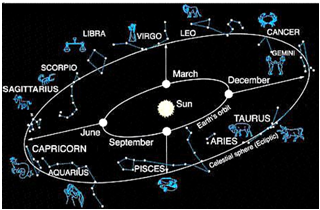
As Earth orbits the sun, the sun appears to pass in front of different constellations. The signs are derived from the constellations that mark out the path on which the sun appears to travel over the course of a year. During Navratri (around October), winter season approches; and before sun-rise, we can visualise the constellation “Simha” (Leo) {सिंह-राशि} and later Kanya कन्या-राशि (Virgo) on the horizon as ascendants. Hence we can visualises the image  as a “a young woman sitting on lion”. This is the image of Goddess Durga (देवी दुर्गा). Durga ji is generally depicted as a woman standing atop or riding a  lion, which represents power, will, and determination. The lion is a symbol of uncontrolled animalistic tendencies such as anger, arrogance, selfishness, greed, jealousy, desire to harm others etc. The image of  Durga on lion reminds us to have a control on these tendencies and protect your mind from vitiating from these evil tendencies.

zodiacDurga

The Sanskrit word Durga (दुर्ग) means fort or a place that is protected and thus difficult to reach. It is derived from the roots ‘dur (दुर्)‘ (difficult) and ‘gam (गम)‘ (pass, go through). In Sanskrit fortress is called DURG, That is why these two periods have been termed as NAV DURGA also. Thus DURGA refers to a fortress that we build to protect ourselves from marauders. Thus, Durga  is the psychological fortress of our body and mind that we build by making a system leading life and get them audited regularly by regulating your life style.

Because of the begining of the change of season, during these periods human body becomes more prone to diseases as it is less resistant, both physically and mentally to the attack of outside environment, micro organism, bacteria and viruses. Remedial measures to combat the possible disease is the deep significance in celebrating the NAVRATRI. Our body acts as a fortress  for us; and body’s immune system is the army that  defends our body-systems from the outside environment and foreign bodies such as micro organism, bacteria and viruses. According to Ayurveda, fasting enegises the digestive fire. An increase in the digestive fire burns the toxins in the body. When the toxins are flushed out of the body, it loses dullness and lethargy. It helps in de-stressing and building up immunity. All the cells of the body are rejuvenated. Fasting, therefore, is an effective therapy to cleanse our body.

NavDurga signifies that we should renew our body system (DURGA) by detoxifying through keeping fast, purifying the environment by HAVAN or YAGYA. Also we need to get rid of all the negative feelings and emotions. Our nervous system needs to be strengthened by performing a specific meditation (SADHANA) and prayer each night of NAVRATRI in the manner specified for that (NAV DURGA) day in order to rejuvenate our mind and nerves in order to make our body capable to fight disease and get success in life. Thus, there are three rituals that are followed during Nav-Durga days in order to stregthen our own two fortress (Durga दुर्ग) body and mind:

  1. Fasting
  2. Yagya
  3. Prayer and Celebration

When the body is cleansed, the mind becomes calmer and more peaceful and alert because of the deep connection between the body and mind. Fasting is combined with prayer all over the world and in all religions, because when you are fasting, you are detoxified, and your prayer becomes authentic and deep.

Yagya and Havan purifies the environment from bacterias and viruses that may cause

diseases.

Prayer and celebrations for that fill us with the positive energythat strengthen our nervous system.

Goddess Durga symbolizes the divine forces (positive energy) known as divine shakti (feminine energy/ power) that is used against the negative forces (negative energy and vices—arrogance, jealousy, prejudice, hatred, anger, greed and selfishness) of evil and wickedness. Shakti  means power, the resort of all transformative energy. She is Chit-Shakti, the power of consciousness, out of which the cosmos coalesces as matter, life and mind.

गीता-गीत GITA-GEET गीता चतुर्थ अध्याय श्लोक (1-9) Gita-Chapter 4 Verses (1-9)

गीता-गीत GITA-GEET

गीता चतुर्थ अध्याय श्लोक (1-9) Gita-Chapter 4 Verses (1-9)

अवतार रहस्य (SECRET OF INCARNATION)

श्री भगवानुवाच

इमं विवस्वते योगं प्रोक्तवानहमव्ययम्‌ ।

विवस्वान्मनवे प्राह मनुरिक्ष्वाकवेऽब्रवीत्‌ ॥1॥

        विवस्वान को कहा था मैंने, यह योग सनातन महान

           मनु ने विवस्वान से, मनु से इक्ष्वाकु ने पाया ज्ञान॥4-1॥

Lord Krishna said that he taught Vivasvan Soorya,

the eternal science of right action,

Vivasvan told the same to Manu, the father of mankind

and Manu conveyed it to Ikshvaku, his son. (4-1)

एवं परम्पराप्राप्तमिमं राजर्षयो विदुः ।

स कालेनेह महता योगो नष्टः परन्तप ॥2॥

                                        ऐसे परम्परा से प्राप्त, राजर्षियों ने जाना यह ज्ञान |

                                        कालांतर से लुप्त हो गया, हे अर्जुन! यह योग महान ||4-2||

This supreme science of yoga was thus received through the chain of disciple succession, and the saintly kings understood it in that way. But in course of time the succession was broken, and therefore the science as it appears to be lost. (4-2)

स एवायं मया तेऽद्य योगः प्रोक्तः पुरातनः ।

भक्तोऽसि मे सखा चेति रहस्यं ह्येतदुत्तमम्‌ ॥3॥

मेरे द्वारा आज कहा गया यह वह योग पुरातनतम |

    तुम हो मेरे भक्त व सखा निश्चय यह रहस्य उत्तम॥4-3॥

That very ancient science of the relationship with the Supreme is today told by Me to you because you are My devotee as well as My friend; therefore, you can understand the transcendental mystery of this science. (4-3)

अर्जुन उवाच

अपरं भवतो जन्म परं जन्म विवस्वतः ।

      कथमेतद्विजानीयां त्वमादौ प्रोक्तवानिति ॥4॥

आप तो इस समय जन्मे, विवस्वान का जन्म पुराना |

         मैं कैसे यह समझ लूं, उन्होंनें आरम्भ में तुमसे जाना||4-4||

Arjun said that Vivasvan Surya was born  earlier so is much senior

How can I agree that you instructed him, as by birth you are much junior (4-4)

श्रीभगवानुवाच

बहूनि मे व्यतीतानि जन्मानि तव चार्जुन ।

      तान्यहं वेद सर्वाणि न त्वं वेत्थ परन्तप ॥5॥

बहुत से जन्म हो चुके हैं, सुनो हे अर्जुन मेरे तुम्हारे |

              तुम्हें नहीं कुछ ज्ञात अर्जुन!, किन्तु जानता हूँ मैं सारे||4-5||

Because of past actions, you have no intuitional knowledge. The eye of wisdom is not opened, power of vision is not present. So, you do not know your previous births. But I know them.

अजोऽपि सन्नव्ययात्मा भूतानामीश्वरोऽपि सन्‌ ।

प्रकृतिं स्वामधिष्ठाय सम्भवाम्यात्ममायया ॥6॥

अजन्मा भी होते हुए, अविनाशी आत्मा,

समस्त प्राणियों का भी  होकर परमात्मा|

स्वयं को अपनी प्रकृति में अधिष्ठित कर,

      आत्म-माया से  जन्म लूं ,बन जीवात्मा ||4-6||

Being birth-less; un-decaying by nature

As the Lord of all existences, I take their care

Yet subjugating My Prakriti, consisting of the three gunas,

As though born, embodied through my Maya, I appear

यदा यदा हि धर्मस्य ग्लानिर्भवति भारत ।

      अभ्युत्थानमधर्मस्य तदात्मानं सृजाम्यहम्‌ ॥7॥

जब जब धर्म का होता है ह्रास |

अर्जुन! अधर्म का होता विकास ||

तब तब सृजन करता मैं स्वयं को|

             शरीर के संग करने भू-पर निवास||4-7||

O! son of Bharat! whenever on earth righteousness becomes less

I create Myself in suitable body form, when there is exaltation of unrighteousness.

krishna in mahabharat

परित्राणाय साधूनां विनाशाय च दुष्कृताम्‌ ।

    धर्मसंस्थापनार्थाय सम्भवामि युगे युगे ॥8॥

भक्तों का करने उद्धार,  दुष्टों का करने संहार|

            धर्मपुनर्स्थापन के हित युग युग में लेता अवतार||4-8||

For the protection of  saints, and the evil-doers’ destruction,

To re-establish righteousness, in every era, I come as incarnation.

जन्म कर्म च मे दिव्यमेवं यो वेत्ति तत्वतः ।

     त्यक्तवा देहं पुनर्जन्म नैति मामेति सोऽर्जुन ॥9॥

जन्म और कर्म मेरे होते सभी दिव्य,

तत्व से ऐसा जो व्यक्ति जान-जाता |

त्याग कर देह न पुनर्जन्म पाता फिर,

              वह हे अर्जुन! सीधे मुझको पा  जाता ||4-9||

One who knows Arjun! that My birth and deeds are divine.

After leaving body, he is not born again but attains place of mine.


LEARNING

Birth of Divine Power: For the sake of firmly establishing righteousness, Supreme Power takes birth in every age. Whenever virtue subsides and immorality prevails, the Supreme divine power comes on the earth to guide human-being. As Lord Krishna was born five thousand years ago, Jesus Christ also took birth more than two thousand years ago to establish a new religion Christianity to show us the path of compassion and love. Needs of people vary with the time according to the environment prevailing at that time. Accordingly, Divine persons take action to improve the condition of human-being and guide them accordingly.

Both Super soul (God) and souls are ‘unborn’ in the sense that they are not created by anyone but are evolved by the nature with the help of consciousness from the Supreme conscious energy.

  1.  Souls are born in the sense that they take birth due to past ‘karma’.
  2. The Super-soul (Param-atma) has no Karma for which he has to take a

body. The Super-soul (Param-atma)

–          is born in the sense that He takes birth due to ‘karuna’ (pity), but

–          unborn in the sense that he is unaffected by past karma, and is born of his own free will.

Param-atma comes as an incarnation based on the conditions of the world. Birth of Super-soul takes place after controlling trinity of nature (trigunamayee prakriti) through divine process (Maya).

Karma or action of Super-soul in incarnation is to protect good features and to destroy bad characteristics. Super-soul’s birth and actions, both are divine. One who knows  both, is having  knowledge of original elements of nature and energy (i.e. tatva-darshee) . Soul (Atma) is the Supreme Element (param-tatva) and if atma joins param tatva then merges with Paramatma. Then it will not be possible to take rebirth., He does not abandon the world. He comes to set things right and show the path.

Lord Krishna, Buddha, Jesus Christ were the such Super Soul who showed the path of righteousness to human-being.

In order to become super-soul, one should act for the benefits of the society as whole (i.e. with Karuna) and not to react against environment for the personal benefits only.

Lord Krishna said, “Anyone who leaves his body after knowing My Divine Birth and Action, is not born again but comes to Me i.e. he is liberated from the cycle of life and death.”